Key takeaways
- Never use threaded hooks or eye screws rated below 500 lbs, no matter how sturdy the swing claims to be — they’re the most common point of failure.
- Check all bolts and hanger hardware every 90 days, especially after heavy rain or temperature swings that cause wood expansion and contraction.
- Apply a penetrating wood sealant to the mounting area annually if your porch is exposed to moisture; a weakened beam makes perfect hangers irrelevant.
- If your swing chains creak, hit the swivel joints with a silicone-based lubricant — never use WD-40, which attracts dust and gunk that shortens the joint’s life.
What's inside
Most porch swing fails don’t come from bad wood or weak chains — they come from a mismatch between the hanger hardware, the ceiling structure, and the swing itself. That gap is where splintered beams and bent bolts live. Whether you’re putting up your first swing or upgrading aging hardware, getting the attachment right means the difference between a quiet weekend seat and a visit from your insurance adjuster.
This guide walks through the full process: reading your porch structure, picking the right hangers and swing for your space, and fastening everything so it actually holds up to daily use. You’ll also find gear recommendations that we’ve vetted for load capacity, durability, and ease of install — no guesswork required.
As an Amazon Associate we earn from qualifying purchases.


Start With Your Ceiling: What It Needs to Handle
Before you buy anything, climb up and look at the framing where you want to mount. A porch ceiling made of decorative beadboard won’t hold a swing — you need solid structural members. Look for exposed joists or beams at least 2×8 inches in size. A single person swinging gently puts 400–600 lbs of dynamic force on the mounting point, and that number spikes when two adults share a seat or a kid launches off one end. If your ceiling is finished and you can’t see the framing, use a stud finder rated for joist detection, or drill a small exploratory pilot hole to locate a beam. Ideally, your hangers will screw directly into a beam running perpendicular to the swing’s motion. If the only option is a joist, confirm it’s at least 2×8 and that you’re mounting into the joist’s center — not the edge.
Choose Hangers Rated for Real Weight, Not Just the Swing’s Listing
Swing manufacturers list static load capacity, but dynamic force during actual use multiplies that number. A 600-lb swing rated for three people can generate well over 1,000 lbs of peak force with a little momentum. For that reason, the single most important spec on any swing hanger is its rated capacity — and you want a serious margin above what you’ll actually load onto it. The ABUSA Heavy Duty hangers, rated for over 5,000 lbs and sold as a two-pack with all mounting bolts included, offer a level of overkill that we find reassuring for a permanent installation. If you want a slimmer profile with stainless steel corrosion resistance and a 360-degree swivel, the VINGLI Heavy Duty Swing Hangers are rated for 2,000 lbs and are especially well-suited for coastal or humid climates where exposed hardware takes a beating. Either way, look for hangers with a swivel joint so the swing can move freely without grinding your mounting bolts sideways.
Match the Swing to the Space and the Hardware
A 3-foot swing on a narrow stoop makes more sense than a 5-foot bench that crowds every trip to the front door. For smaller porches under 8 feet wide, a compact option like the VINGLI 4 FT Wooden Porch Swing keeps the footprint manageable while still supporting 880 lbs — plenty for two adults. If you have a generous covered patio or wrap-around porch, the VINGLI XL 5 FT Pro swings wide enough for three with the bonus of built-in cup holders, which sounds trivial until you realize how often you’ll use them. The VEVOR 5 FT swing offers similar capacity at a lower price point with a clean brown finish that blends well with natural wood porches. For renters or anyone who doesn’t want to drill into a ceiling, a freestanding option like the Yaheetech 3-Seat Patio Swing with its adjustable sunshade and removable cushions sidesteps the mounting question entirely — though you sacrifice that smooth, anchored swing feel.
Install With the Right Fasteners and the Right Depth
Once you’ve paired your hangers to a structural beam, use lag bolts (not standard screws or drywall anchors — ever). Most heavy-duty hanger kits include lag bolts sized for standard lumber, but verify they penetrate at least 3 inches into solid wood. Pre-drill pilot holes slightly smaller than the bolt shaft to prevent splitting, and torque each bolt down snugly without over-driving — you want the hanger pulled tight against the beam, not buried into it. Attach your swing’s chains or ropes to the hanger’s swivel eye, and before you sit down, give it a firm pull test by hand. Bounce on it once while standing close to the ground to feel for any give, creak, or lateral shift. If anything moves, tighten before anyone actually relaxes in it.
Tips
- Never use threaded hooks or eye screws rated below 500 lbs, no matter how sturdy the swing claims to be — they’re the most common point of failure.
- Check all bolts and hanger hardware every 90 days, especially after heavy rain or temperature swings that cause wood expansion and contraction.
- Apply a penetrating wood sealant to the mounting area annually if your porch is exposed to moisture; a weakened beam makes perfect hangers irrelevant.
- If your swing chains creak, hit the swivel joints with a silicone-based lubricant — never use WD-40, which attracts dust and gunk that shortens the joint’s life.
Frequently Asked Questions
How far apart should the two hangers be spaced?
Measure the distance between the attachment points on your swing’s frame — typically 6 to 10 feet apart for a standard bench swing — and mount your hangers directly above those points. Misalignment creates uneven force distribution, which stresses one hanger more than the other and causes the swing to track sideways instead of gliding straight.
Can I hang a porch swing from a pergola instead of a solid ceiling?
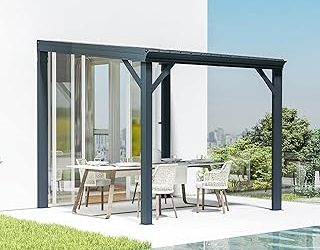
It depends on the pergola’s construction. A heavy cedar or pressure-treated pergola with thick crossbeams can support a swing rated for 300 lbs or less if you attach to the primary beams, not the decorative slats above them. For any swing rated higher, a pergola is likely too flexible — go with a solid beam or consult a contractor about reinforcement.
Do I need special tools for the installation?
A drill with a socket adapter for lag bolts, a stud finder, a level, and a 3/8-inch drill bit will cover most installations. Some hanger kits, like the ABUSA pack, include the bolts and an Allen wrench, but you’ll still need your own drill for the pilot holes. The whole process typically takes 45 minutes to an hour with basic tools.
Is a swivel hanger necessary or just a nice-to-have?
It’s functionally necessary. Without a swivel, the swing’s chains pull against the mounting bolts at an angle every time you move, creating a grinding action that loosens hardware and stresses the beam over time. A swivel lets the hanger rotate freely with the swing’s motion, keeping the force vertical and the bolts where they belong.
Conclusion
Hanging a porch swing well is mostly about respecting the physics: strong hardware, solid structure, correct spacing, and regular maintenance. Pick hangers with a load rating well above your swing’s capacity, anchor them into verified structural framing, and check everything periodically. Do those three things and you’ll have a swing that quietly lasts for years instead of one that fails on a Saturday afternoon.