Key takeaways
- Fence vs. Crosscut Orientation: Decide whether you need a dedicated crosscut sled for repeatable 90° cuts or a multi-purpose sled kit you can build to your own specs. Crosscut sleds shine for small-part work; kits give you flexibility.
- Zero-Clearance Support: Look for sleds with built-in zero-clearance fences or replaceable inserts. This dramatically reduces tearout on thin stock and tiny decorative pieces — the kind of cuts where a standard miter gauge leaves ragged edges.
- Miter Bar and Track Compatibility: Verify that the sled’s miter bar or T-track matches your saw’s miter slot. Most consumer saws use a standard 3/4-inch slot, but measuring before you buy prevents a return trip.
- Material and Build Quality: Aluminum rails and UHMW plastic bars hold up under repeated use and stay smooth in the slot. All-wood jigs can warp with humidity changes, which defeats the purpose of a precision tool.
- Intended Workpiece Size: A compact sled optimized for dowels and tenons is a different beast than a slab-flattening gantry rated for river tables. Match the sled’s capacity to your typical project dimensions and save yourself from buying twice.
What's inside
If you’ve ever tried to crosscut a narrow dowel or flatten a live-edge slab on a standard table saw setup, you know the frustration: wobbly cuts, inconsistent angles, and a nagging sense that your hands are closer to the blade than they should be. Most factory miter gauges ship with imprecise tolerances, and that gap between “good enough” and “spot-on” shows up every time you try to repeat a cut.
This guide cuts through the noise. We tested and compared the most popular table saw sleds and sled kits available in 2026 — from compact crosscut solutions for small parts to full slab-flattening gantry systems — so you can match the right jig to the work you actually do.
As an Amazon Associate we earn from qualifying purchases.


How to Choose a Table Saw Sled (2026)
- Fence vs. Crosscut Orientation: Decide whether you need a dedicated crosscut sled for repeatable 90° cuts or a multi-purpose sled kit you can build to your own specs. Crosscut sleds shine for small-part work; kits give you flexibility.
- Zero-Clearance Support: Look for sleds with built-in zero-clearance fences or replaceable inserts. This dramatically reduces tearout on thin stock and tiny decorative pieces — the kind of cuts where a standard miter gauge leaves ragged edges.
- Miter Bar and Track Compatibility: Verify that the sled’s miter bar or T-track matches your saw’s miter slot. Most consumer saws use a standard 3/4-inch slot, but measuring before you buy prevents a return trip.
- Material and Build Quality: Aluminum rails and UHMW plastic bars hold up under repeated use and stay smooth in the slot. All-wood jigs can warp with humidity changes, which defeats the purpose of a precision tool.
- Intended Workpiece Size: A compact sled optimized for dowels and tenons is a different beast than a slab-flattening gantry rated for river tables. Match the sled’s capacity to your typical project dimensions and save yourself from buying twice.
The Best Table Saw Sled (2026)s Reviewed
Small Crosscut Sled with Zero-Gap Support
This compact aluminum sled is purpose-built for the cuts most jigs handle poorly: thin dowels, small tenons, and narrow decorative lines. The zero-gap support system keeps tiny parts from vibrating or slipping, and the aluminum slide rails track smoothly in standard miter slots. If your work leans toward model-making, inlay, or small furniture joinery, this sled solves a problem nothing else on the bench addresses well.
POWERTEC 71403 Crosscut Sled
The POWERTEC 71403 hits the sweet spot between a ready-to-use sled and a customizable jig. It ships with a hardware kit that includes the fence, hold-down clamp, and miter bar, so you’re up and running within an hour. The 90° fence is adjustable and locks solid, making it a reliable daily driver for general crosscutting on mid-size stock. For woodworkers who want a step up from the factory miter gauge without designing a sled from scratch, this is the practical choice.
Rockler Small Parts Crosscut Sled
Rockler’s sled focuses entirely on safe, precise small-part cutting — and it nails the brief. The zero-clearance platform holds even the tiniest offcuts flat against the fence, so your fingers stay well away from the blade path. The build quality is solid for a production jig, and the fence alignment holds up straight out of the box. If you regularly cut small components for jewelry boxes, toys, or drawer hardware, this sled earns its space on the saw.
O’SKOOL Slab Flattening Router Sled
This one breaks the crosscut mold entirely. The O’SKOOL gantry system mounts a 3.5-inch router and lets you plane wide slabs, river tables, and workbench tops that would never fit under a jointer or planer. The three-axis travel is smooth and the extruded aluminum rails resist flex across the full span. It’s a serious piece of shop infrastructure, but if you work with live-edge slabs, it replaces thousands of dollars in industrial flattening equipment.
21P Table Saw Sled Kit
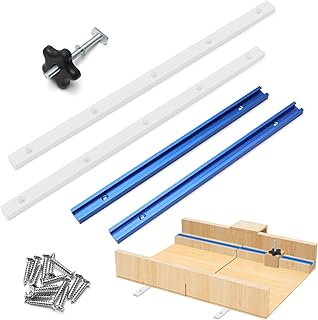
For builders who’d rather design their own sled, the 21P kit bundles two aluminum T-tracks, two UHMW miter bars, predrilled mounting hardware, and a locking knob into one package. The miter bars slide without play in standard slots, and the T-tracks accept common hold-down clamps and stop blocks. It’s not a finished sled — it’s the foundation for one, and priced well for the quality of components you get.
Frequently Asked Questions
Do I need a crosscut sled if I already have a miter gauge?
For general 90° cuts on wider boards, a good miter gauge works fine. A crosscut sled earns its keep when you need repeatable accuracy on small parts, zero-clearance support to prevent tearout, or safer handling of narrow stock that’s difficult to hold against a gauge fence.
Will these sleds fit my table saw?
Most sleds and kits listed here use miter bars or tracks designed for the standard 3/4-inch by 3/8-inch miter slot found on the majority of cabinet and contractor saws. Measure your slot before ordering, especially if you own a European-format saw with a non-standard groove.
What’s the difference between a sled kit and a finished sled?
A finished sled arrives as a complete unit ready to place on your saw. A kit provides the critical hardware — bars, tracks, knobs, and screws — while you supply the wood base and fence. Kits cost less and let you customize dimensions, but they require some woodworking skill to assemble properly.
Can a slab-flattening sled replace a planer?
It replaces a wide planer for boards that exceed a planer’s capacity, not for routine stock. A slab-flattening jig is specifically designed for irregular, oversized pieces like live-edge tops and glued-up panels that are too wide, too thick, or too uneven to feed through a standard planer safely.
Final Thoughts
For most home woodworkers tackling small-part crosscuts, the Rockler Small Parts Crosscut Sled and the POWERTEC 71403 are the strongest all-around picks — one optimized for tiny work, the other for everyday cuts on mid-size stock. If your shop deals in live-edge slabs, the O’SKOOL gantry system is a worthwhile investment that pays for itself quickly. Match the sled to your most common cut, and every project after that gets a little more precise.