Key takeaways
- Cubic footage vs. your stuff: A 1.7 cu.ft unit handles drinks and snacks comfortably; anything below that and you’re essentially buying a cooler that plugs in. If you plan to store full meals, aim for 3.0 cu.ft or higher.
- Noise level: Compressor-based fridges typically run between 35–45 dB. If your bed shares a wall with the fridge, look for models that stay under 40 dB—your future roommate will thank you.
- Freezer presence: Some mini fridges skip the freezer entirely or offer just a tiny icebox section. If you eat frozen meals regularly, confirm the freezer compartment is genuinely usable and not a 6-inch afterthought.
- Energy certification: Energy Star–rated models can save $15–$25 annually on your electricity share. Over a four-year degree, that adds up—and most dorm housing agreements factor in energy usage.
- Door swing and ventilation: Check whether the door is reversible and how much clearance the back and sides need. Dorms often pin fridges against walls, and poor ventilation shortens compressor life noticeably.
What's inside
Shopping for a dorm mini fridge is one of those tasks that sounds simple until you’re staring at a dozen listings with nearly identical descriptions and wildly different footprints. The reality is that dorm rooms have tight square footage, shared electrical outlets, and noise-level expectations that matter when your bed is four feet from your compressor. Pick the wrong unit and you’re dealing with a freezer that can’t hold more than a frozen pizza or a fan that sounds like a propeller plane at 2 a.m.
After evaluating capacity, energy draw, noise output, and real-world usability, this guide breaks down the top mini fridges worth considering for dorm life in 2026. Whether you need a tiny thermoelectric unit for skincare products or a full two-door setup that rivals your apartment kitchen, these picks cover the range of what actually works in a dorm setting.
As an Amazon Associate we earn from qualifying purchases.


How to Choose a Mini Fridge For Dorm Rooms (2026)
- Cubic footage vs. your stuff: A 1.7 cu.ft unit handles drinks and snacks comfortably; anything below that and you’re essentially buying a cooler that plugs in. If you plan to store full meals, aim for 3.0 cu.ft or higher.
- Noise level: Compressor-based fridges typically run between 35–45 dB. If your bed shares a wall with the fridge, look for models that stay under 40 dB—your future roommate will thank you.
- Freezer presence: Some mini fridges skip the freezer entirely or offer just a tiny icebox section. If you eat frozen meals regularly, confirm the freezer compartment is genuinely usable and not a 6-inch afterthought.
- Energy certification: Energy Star–rated models can save $15–$25 annually on your electricity share. Over a four-year degree, that adds up—and most dorm housing agreements factor in energy usage.
- Door swing and ventilation: Check whether the door is reversible and how much clearance the back and sides need. Dorms often pin fridges against walls, and poor ventilation shortens compressor life noticeably.
The Best Mini Fridge For Dorm Rooms (2026) Reviewed
Cooluli 4L Mini Fridge
The Cooluli isn’t trying to replace a real refrigerator—it’s a thermoelectric cooler-warmer designed for skincare, a handful of cans, or snacks you want chilled at your desk. It runs on AC, DC, and USB, which makes it surprisingly versatile for dorm setups where outlet space is limited. If your needs lean more toward keeping a few La Croix cans cold beside your monitor, this is the compact pick.
Upstreman 3.2 Cu.Ft (BR321)
This hits the sweet spot for most dorm dwellers: enough room for a week’s worth of groceries, a functional freezer compartment for ice cream and frozen burritos, and a noise level that won’t register above a whisper. The reversible door is a genuine convenience in cramped rooms, and the adjustable thermostat gives you more control than most competitors at this price point.
Midea 3.1 Cu.ft With Freezer
Midea’s Energy Star certification is the headline here, but the build quality supports it. The interior layout is thoughtfully proportioned—tall bottle storage, usable freezer space—and the compressor runs noticeably quieter than many 3+ cu.ft alternatives. For students sharing a kitchen bill, the lower energy footprint alone justifies stepping up from a smaller unit.
Upstreman 1.7 Cu.ft (FR171)
When floor space is genuinely scarce, this compact option fits where larger fridges won’t. It still includes a small freezer compartment, and the adjustable thermostat prevents the common problem of compact fridges running too cold or too warm. It won’t hold a gallon of milk upright, but for a single student’s drinks and basic food storage, it punches above its size.
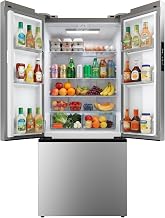
4.5 Cu.Ft Two-Door Mini Fridge
This is the dorm fridge for someone who cooks. The separate freezer door means your frozen goods aren’t fighting for space with refrigerated items, and the 38 dB noise rating keeps it quiet despite the larger compressor. Adjustable shelving and a 7-level thermostat round out what is essentially a scaled-down apartment fridge—ideal for students who skip the meal plan entirely.
Frequently Asked Questions
Are mini fridges allowed in dorm rooms?
Most colleges permit mini fridges under 5 cubic feet, but your specific residence hall may enforce a lower cap. Always check with your housing office before purchasing—a 4.5 cu.ft model could violate policy at institutions that limit units to 3.5 cu.ft.
How much electricity does a dorm mini fridge use?
Smaller thermoelectric models draw around 50–60 watts, while compressor-based units in the 3–4 cu.ft range typically use 80–120 watts. An Energy Star–certified fridge in this category generally costs $25–$40 per year to run at average U.S. electricity rates.
Can I put a mini fridge on a carpeted floor?
Avoid it if possible. Carpet traps heat around the compressor’s base and restricts airflow underneath, forcing the motor to work harder. If you have no choice, slide a thin rigid board underneath to create a flat, ventilated surface.
What’s the difference between thermoelectric and compressor mini fridges?
Thermoelectric models use a fan-based Peltier system—they’re lighter, silent, and can both cool and warm, but they struggle to go below about 40°F in warm rooms. Compressor fridges work like full-size refrigerators: colder, more consistent, and capable of freezing, but heavier and slightly noisier.
Final Thoughts
For most dorm situations, the Upstreman 3.2 Cu.Ft offers the best balance of capacity, noise, and value. Students watching their energy bills should lean toward the Midea 3.1 Cu.ft for its certified efficiency. And if you need genuine two-door separation and maximum storage, the 4.5 Cu.Ft Two-Door model is the closest you’ll get to a kitchen refrigerator without leaving your room.