Key takeaways
- Tooth count: Higher teeth (60–80) produce smoother finish cuts in hardwood but generate more heat during rip cuts. Lower counts (32–40) clear chips faster and reduce burning on long rip passes, making a two-blade setup ideal for mixed work.
- Grind type: ATB (Alternate Top Bevel) is the all-rounder for crosscuts and rips in hardwood. Hi-ATB or triple-chip variants trade versatility for ultra-smooth surfaces on figured species but dull faster in heavy ripping.
- Kerf width: Full-kerf blades (roughly 1/8 inch) stay truer under load and resist deflection on thick hardwood slabs. Thin-kerf options save material and strain your motor less, which matters if your saw runs on a standard 15-amp circuit.
- Arbor size: Confirm your saw’s arbor before ordering. Most cabinet and contractor saws use a 5/8-inch arbor, but some larger 12-inch models require a 1-inch bore. Buying the wrong size means an unnecessary return.
- Carbide quality: Premium micro-grain carbide tips stay sharp significantly longer and resharpen more cleanly. Budget blades are fine for rough dimensioning, but a quality-tipped blade pays for itself when every hardwood board costs $8 per board foot or more.
What's inside
Hardwood demands more from a saw blade than softwood ever will. Dense species like white oak, maple, and hickory punish dull or poorly specked cutters with burn marks, tearout, and motor strain — problems that waste expensive lumber and test your patience. If you have been swapping blades every few months or sanding through rough crosscuts just to get a clean edge, the issue likely traces back to tooth count, grind geometry, or carbide quality rather than your saw itself.
This guide walks through the table saw blades that actually hold up to repeated hardwood use in a home shop. We evaluated each option on cut cleanliness, blade flatness out of the box, kerf width, and long-term carbide retention so you can match a blade to your specific workflow without guessing.
As an Amazon Associate we earn from qualifying purchases.
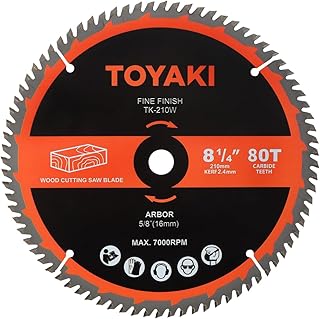


How to Choose a Table Saw Blade for Hardwood (2026)
- Tooth count: Higher teeth (60–80) produce smoother finish cuts in hardwood but generate more heat during rip cuts. Lower counts (32–40) clear chips faster and reduce burning on long rip passes, making a two-blade setup ideal for mixed work.
- Grind type: ATB (Alternate Top Bevel) is the all-rounder for crosscuts and rips in hardwood. Hi-ATB or triple-chip variants trade versatility for ultra-smooth surfaces on figured species but dull faster in heavy ripping.
- Kerf width: Full-kerf blades (roughly 1/8 inch) stay truer under load and resist deflection on thick hardwood slabs. Thin-kerf options save material and strain your motor less, which matters if your saw runs on a standard 15-amp circuit.
- Arbor size: Confirm your saw’s arbor before ordering. Most cabinet and contractor saws use a 5/8-inch arbor, but some larger 12-inch models require a 1-inch bore. Buying the wrong size means an unnecessary return.
- Carbide quality: Premium micro-grain carbide tips stay sharp significantly longer and resharpen more cleanly. Budget blades are fine for rough dimensioning, but a quality-tipped blade pays for itself when every hardwood board costs $8 per board foot or more.
The Best Table Saw Blades for Hardwood (2026) Reviewed
WEN BL1080 10-Inch 80-Tooth
WEN’s BL1080 punches well above its price class for finish crosscuts in hardwood. The 80 ATB teeth leave a surface that often needs zero sanding on maple and cherry, and the 1/8-inch kerf gives the blade enough mass to track straight through 8/4 stock without wandering. A solid pick if you want one blade that covers both table saw and miter saw duty.
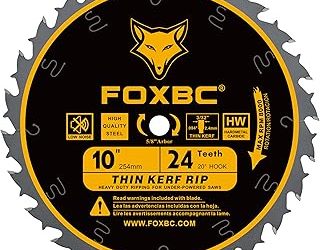
FOXBC 10-Inch 80-Tooth Ultra Finish
The FOXBC 80T runs noticeably quiet for a blade this aggressive and delivers crisp end grain on walnut and oak with minimal tearout. It ships with a thin 5/8-inch arbor fit and stays flat under moderate feed rates, which makes it a strong choice for woodworkers who value surface quality over raw feed speed.
KENDO 10-Inch Circular Saw Blade 2-Pack (40T & 60T)
KENDO’s two-blade set gives you a purpose-built rip blade and a finish blade in one purchase, removing the guesswork of building a balanced kit from scratch. The 40-tooth rips through straight-grained hardwood without burning, while the 60-tooth handles crosscuts and plywood with a clean result that holds up under finish.
10-Inch 3-Pack (32T, 60T, 80T)
This variety pack covers every stage from rough dimensioning to ultra-fine finish work, which is rare at this price point. The 32-tooth blade clears thick hardwood rips quickly, the 60T handles general joinery cuts, and the 80T delivers glass-smooth surfaces on figured grain — all with a standard 5/8-inch arbor that fits most 10-inch saws.
SawWorks 12-Inch 60T ATB
SawWorks targets cabinet-shop operators with this 12-inch blade, and it delivers the rigidity and flatness those larger saws demand. The 60-tooth ATB grind balances chip clearance with finish quality in hardwoods up to 3 inches thick, and the 1-inch arbor suits serious stationary saws rather than compact contractor models.
Frequently Asked Questions
Can I use one blade for both ripping and crosscutting hardwood?
You can with a 40-tooth ATB blade, but the result will always be a compromise. A dedicated rip blade clears waste faster and runs cooler during long grain cuts, while a higher-tooth finish blade leaves smoother crosscut surfaces. Many home shop woodworkers settle on two blades and swap as needed for the best results.
How often should I replace my table saw blade for hardwood work?
A quality carbide blade should cut cleanly for roughly 100 to 200 hours of hardwood use before performance drops noticeably. You will know a blade is spent when you start seeing burn marks at normal feed rates, or when the surface requires more sanding than usual after a pass.
Does tooth count matter more than blade quality?
Blade quality matters more. A well-made 40-tooth blade with sharp micro-grain carbide will outperform a cheap 80-tooth blade that dulls after a few sessions. Invest in a reputable manufacturer first, then select the tooth count that matches your cut type.
What causes burn marks when cutting hardwood?
Burns typically result from dull carbide, excessive feed pressure, a misaligned fence, or using too high a tooth count for a rip cut. Checking blade sharpness and reducing downward pressure usually solves the problem quickly, but upgrading to a sharper blade eliminates it long-term.
Final Thoughts
For most home shop woodworkers tackling hardwood, the WEN BL1080 and FOXBC 80T both deliver finish-quality cuts at a reasonable cost, while the KENDO 2-Pack is the most practical starting point if you need both rip and crosscut capability without buying blades piecemeal. Match your choice to your saw’s arbor size and the type of hardwood cutting you do most, and the upgrade from a generic blade will be immediately obvious.