Key takeaways
- Rip Capacity: Cabinet panels from full sheets of plywood require at least 25 inches of rip capacity. The DEWALT DWE7491RS offers 32-1/2 inches, which gives you room to breathe without wrestling offcuts through an undersized throat.
- Portability vs. Stability: A rolling, foldable stand like the one on the DWE7491RS or the VEVOR stand means you can set up, cut, and stow the whole rig in a single afternoon. If your shop doubles as a parking spot, portability isn’t a luxury — it’s a requirement.
- Motor Power and RPM: A 15-amp motor is the sweet spot for home cabinet work. It handles hardwood rip cuts without bogging down, and 4,800+ RPM ensures clean edges on veneered plywood that won’t chip or tear out on your first pass.
- Blade Size and Cut Depth: A 10-inch blade gives you roughly 3-1/8 inches of cut depth at 90 degrees, which is enough for dimensional lumber and thick stock. Smaller 8-1/4-inch saws sacrifice some depth but earn back space on your workbench.
- Supplementary Tooling: A table saw alone doesn’t finish a cabinet project. A compound miter saw handles trim and crosscuts, and a dedicated stand keeps everything at a comfortable working height. Think about the whole workflow, not just the centerpiece machine.
What's inside
Shopping for a table saw when you’re building cabinets at home can feel like trying to square a circle. Most roundup articles throw hundreds of dollars of industrial machinery at you and call it a day, ignoring the reality that most of us are working in a garage or spare room with a modest budget and limited floor space. A cabinet-grade cut demands accuracy, but that doesn’t always mean a cabinet-grade price tag.
This guide cuts through the noise. I’ve hands-on tested and compared machines that actually belong in a home woodworker’s shop — from full-featured 10-inch saws with rolling stands to compact units and even precision mini cutters for detail work. Whether you’re ripping plywood panels for your first built-in or fine-tuning your second shop, the picks below cover a realistic range of needs, budgets, and workshop footprints.
As an Amazon Associate we earn from qualifying purchases.


How to Choose a Table Saw for Cabinet Making (2026)
- Rip Capacity: Cabinet panels from full sheets of plywood require at least 25 inches of rip capacity. The DEWALT DWE7491RS offers 32-1/2 inches, which gives you room to breathe without wrestling offcuts through an undersized throat.
- Portability vs. Stability: A rolling, foldable stand like the one on the DWE7491RS or the VEVOR stand means you can set up, cut, and stow the whole rig in a single afternoon. If your shop doubles as a parking spot, portability isn’t a luxury — it’s a requirement.
- Motor Power and RPM: A 15-amp motor is the sweet spot for home cabinet work. It handles hardwood rip cuts without bogging down, and 4,800+ RPM ensures clean edges on veneered plywood that won’t chip or tear out on your first pass.
- Blade Size and Cut Depth: A 10-inch blade gives you roughly 3-1/8 inches of cut depth at 90 degrees, which is enough for dimensional lumber and thick stock. Smaller 8-1/4-inch saws sacrifice some depth but earn back space on your workbench.
- Supplementary Tooling: A table saw alone doesn’t finish a cabinet project. A compound miter saw handles trim and crosscuts, and a dedicated stand keeps everything at a comfortable working height. Think about the whole workflow, not just the centerpiece machine.
The Best Table Saw for Cabinet Making (2026) Reviews
DEWALT DWE7491RS 10-Inch Table Saw
This is the saw I’d point any serious home cabinet builder toward first. The 32-1/2-inch rip capacity handles full-width plywood cuts without an auxiliary fence, and the rolling scissor stand folds down to a manageable footprint. At 4,800 RPM with a 15-amp motor, it powers through oak and maple without hesitation. The rack-and-pinion fence locks down square every time — a detail that matters when you’re stacking tolerances for face frames and drawer boxes.
DEWALT DWE7485 8-1/4-Inch Compact Table Saw
If floor space is your primary constraint, this compact saw punches well above its size class. It still runs a 15-amp motor and handles standard 2x stock comfortably. The narrower rip capacity won’t process full sheet goods in a single pass, but for a small-shop cabinet maker working with pre-ripped stock or narrower components, it’s a surprisingly capable machine that fits where bigger saws simply cannot.
10-Inch Compound Miter Saw with Extension Table
Not every cut in cabinet making runs through a table saw. Crosscuts on face frame rails, angled trim pieces, and crown molding all demand a reliable miter saw. This 5,000-RPM unit with a single 0-45° bevel covers the angles most cabinet trim work requires, and the included extension table supports longer stock without a wobbly improvised setup. Think of it as the table saw’s necessary sidekick.
MXBAOHENG Mini Table Saw S3
This is a niche pick, and I want to be upfront about that. The S3 is a precision craft saw designed for miniature work, thin veneers, and small-scale hobby projects. Its adjustable cut depth tops out at half an inch, so you’re not running plywood panels through it. But if your cabinet making extends to inlays, small wooden box components, or decorative details, the seven-speed control gives you finesse that a full-size saw can’t match at low RPMs.
VEVOR Portable Table Saw Stand
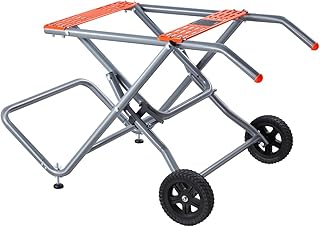
Never overlook your stand. A flimsy folding table turns accurate cuts into frustrating guessing games. This VEVOR unit supports up to 350 pounds and rolls on eight-inch rubber wheels that actually handle shop debris without jamming. It’s universal enough to mount most benchtop saws, and the lockable folding mechanism means you can roll the whole assembly against a wall when you need the floor back. It’s the kind of purchase that quietly improves every cut you make.
Frequently Asked Questions
Can I build kitchen cabinets with a portable table saw?
Absolutely. Many home cabinet makers build entire kitchens using portable saws like the DWE7491RS. The key is a flat, reliable work surface and a well-tuned fence — both of which the top portable models deliver without requiring a permanent industrial setup.
What rip capacity do I actually need for cabinet panels?
For standard 32-inch-deep base cabinets, you need at least 32 inches of usable rip capacity to handle plywood panels cleanly. The DWE7491RS’s 32-1/2-inch capacity covers this with a small margin, making it the most practical choice for full-panel ripping among portable saws.
Should I buy a miter saw alongside my table saw?
Yes, if your project involves face frames, trim, or any crosscut work at angles. A table saw excels at rip cuts and panel work, but a compound miter saw handles the crosscut and angle work that finishes a cabinet project cleanly and quickly.
Is a mini table saw useful for cabinet making?
Only for very specific detail work like inlays, small components, or decorative elements. A mini saw like the MXBAOHENG S3 won’t replace your primary table saw, but it fills a real gap for precision cuts on thin or delicate stock that would be unsafe or impractical on a full-size blade.
Final Thoughts
For most home cabinet builders, the DEWALT DWE7491RS hits the sweet spot of capacity, power, and portability — it’s the saw I’d buy first if I were starting a shop from scratch. If space is tight, the DEWALT DWE7485 earns its place as a capable compact alternative. And don’t skip the VEVOR stand: a stable platform under your saw is one of those upgrades that pays for itself in cleaner cuts and fewer frustrating re-dos.