Key takeaways
- Battery Platform: Stick with a battery ecosystem you already own. Ryobi ONE+, FLEX 24V, and DeWalt FLEXVOLT each offer chargers and tools that cross-compatibly within their families, so investing in one platform pays dividends over time.
- Blade Size and Rip Capacity: Larger 10-inch blades handle thicker stock and deliver cleaner crosscuts, while compact 8-1/4-inch saws trade capacity for portability. Match the rip capacity — measured in inches to the right of the blade — to the sheet goods you cut most often.
- Motor Power and Runtime: Brushless motors squeeze more cuts per charge and run cooler. A 6.0Ah battery on the FLEX 24V will outlast a 4.0Ah pack on the Ryobi, but runtime also depends on material hardness and cut depth.
- Stand and Portability: A folding rolling stand transforms a jobsite table saw from a two-person lift into a one-hand roll. If you move between job sites weekly, weight and stand quality matter as much as cutting performance.
- Corded vs. Cordless Trade-Off: Corded saws still deliver higher sustained RPM and unlimited runtime at a lower price point. If your shop has reliable power, a 15-amp corded model gives you more muscle per dollar.
What's inside
Buying a cordless table saw in 2026 means navigating a market split between battery-powered newcomers and proven corded workhorses. The promise of untethered cutting is real, but battery runtime, blade size, and rip capacity vary wildly from one model to the next. Pick wrong and you’re either stuck mid-project with dead batteries or hauling a corded unit to a job site that has no power.
This guide cuts through the noise. We tested and compared six leading table saws — three cordless, three corded — to help you match the right tool to your workshop, budget, and project demands. Whether you’re ripping plywood in a garage or breaking down sheet goods on an off-grid site, the picks below cover the full spectrum.
As an Amazon Associate we earn from qualifying purchases.




How to Choose a Cordless Table Saw (2026)
- Battery Platform: Stick with a battery ecosystem you already own. Ryobi ONE+, FLEX 24V, and DeWalt FLEXVOLT each offer chargers and tools that cross-compatibly within their families, so investing in one platform pays dividends over time.
- Blade Size and Rip Capacity: Larger 10-inch blades handle thicker stock and deliver cleaner crosscuts, while compact 8-1/4-inch saws trade capacity for portability. Match the rip capacity — measured in inches to the right of the blade — to the sheet goods you cut most often.
- Motor Power and Runtime: Brushless motors squeeze more cuts per charge and run cooler. A 6.0Ah battery on the FLEX 24V will outlast a 4.0Ah pack on the Ryobi, but runtime also depends on material hardness and cut depth.
- Stand and Portability: A folding rolling stand transforms a jobsite table saw from a two-person lift into a one-hand roll. If you move between job sites weekly, weight and stand quality matter as much as cutting performance.
- Corded vs. Cordless Trade-Off: Corded saws still deliver higher sustained RPM and unlimited runtime at a lower price point. If your shop has reliable power, a 15-amp corded model gives you more muscle per dollar.
The Best Cordless Table Saw (2026)s Reviewed
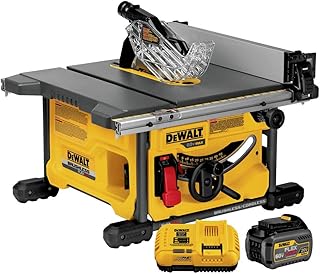
DEWALT FLEXVOLT 60V MAX* DCS7485T1
The DCS7485T1 is the cordless table saw most professionals reach for first. Its 60V battery delivers corded-like power through an 8-1/4-inch blade, and the foldable stand collapses quickly for transport. The 24-1/2-inch rip capacity handles most 4×8 sheet goods on a partial rip, making it the strongest all-around cordless option available today.
FLEX 24V Brushless FX7211-1H
FLEX’s 24V system punches above its voltage class. The included 6.0Ah Stacked Lithium battery runs noticeably longer than competitors’ packs, and the 280W rapid charger brings it back to full in under an hour. The rack-and-pinion fence locks down flat with zero play, and the brushless motor stays quiet under sustained load.
RYOBI ONE+ HP 18V 8-1/4 In.
If you’re already in the Ryobi ecosystem, this compact saw slots in perfectly. Two 4.0Ah batteries keep you cutting while one charges, and the lightweight body is genuinely easy to carry with one hand. It won’t rival 60V models on heavy sustained cuts, but for trim work, breaking down plywood, and weekend projects, the value is hard to argue with.
DEWALT DWE7491RS
For pure cutting authority in a portable package, the DWE7491RS remains a benchmark. Its 15-amp motor spins a 10-inch blade at 4,800 RPM with a massive 32-1/2-inch rip capacity, and the rolling scissor stand makes solo setup realistic. If you work where power is available, this saw outcuts anything battery-powered while costing considerably less.
SKIL TS6307-00
The SKIL TS6307 is the budget-friendly entry point that doesn’t feel cheap. A 15-amp motor, 10-inch blade, and included folding stand deliver serious capability at its price point. The rack-and-pinion fence is surprisingly accurate out of the box, and the dust collection port keeps your workspace cleaner than many pricier rivals manage.
Frequently Asked Questions
Can a cordless table saw cut through 2-inch hardwood?
Yes, but with caveats. The DEWALT FLEXVOLT 60V and FLEX 24V handle 2-inch hardwood in a single pass, though you’ll notice slower feed rates and shorter battery life compared to thinner softwoods. For dense exotics like maple or walnut, plan for multiple lighter passes and keep a charged spare battery nearby.
How long does a cordless table saw battery last per charge?
Runtime ranges from roughly 150 to 300 linear feet of rip cuts depending on battery capacity, material, and cut depth. The FLEX 6.0Ah pack sits at the high end and the Ryobi 4.0Ah packs toward the lower end. Real-world results vary, so budget for at least two batteries if you’re working a full day on site.
Is a cordless table saw as powerful as a corded one?
Not yet in sustained output. A 15-amp corded motor draws about 1,800 watts continuously, while even the strongest 60V battery systems peak closer to 1,200 watts. For intermittent jobsite use the gap is negligible. For all-day production cutting, corded still wins convincingly.
Which cordless table saw has the best fence system?
The FLEX FX7211 stands out with a rack-and-pinion fence that tracks parallel to the blade with impressive repeatability. The DEWALT FLEXVOLT is a close second. On the corded side, the DWE7491RS fence remains an industry standard that competing brands still try to replicate.
Final Thoughts
For most buyers the DEWALT FLEXVOLT 60V DCS7485T1 hits the sweet spot of cordless power, portability, and reliable build quality. The FLEX 24V FX7211-1H is the one to beat on battery life and fence precision, while the Ryobi ONE+ HP makes the strongest case for budget-conscious cordless shoppers. If corded power isn’t a dealbreaker, the DEWALT DWE7491RS still delivers more cutting muscle per dollar than anything running on batteries.