Key takeaways
- Tank Size and Portability: A 1–2 gallon tank suits light inflation and brad nailing, while 6+ gallon tanks keep up with longer spray-painting or finish-nailing sessions without constant motor cycling. Consider how often you’ll move the unit between your garage and job area.
- Noise Output: Cheap compressors can easily exceed 90 dB, which is loud enough to require hearing protection indoors. Models rated under 60 dB let you work in shared living spaces without disturbing the household — especially important if your workspace doubles as a den or guest room.
- CFM and PSI Ratings: CFM (cubic feet per minute) at a given PSI tells you how much air the unit actually delivers under load. A 12V inflator at 150 PSI is fine for tires, but finish-nailers and sprayers typically need at least 2–3 CFM at 90 PSI to avoid stalling.
- Power Source: 12V DC models plug into your car’s cigarette lighter and shine for roadside emergencies and outdoor use. Corded 110V units provide steadier output for garage work, while battery-powered inflators offer true cordless freedom at the expense of run time.
- Maintenance and Oil-Free Design: Oil-free pumps are nearly maintenance-free and can run in any orientation, which matters if you store the compressor tilted in a tight cabinet. Oil-lubricated units run smoother but demand periodic changes and level surfaces.
What's inside
Most homeowners don’t realize they need a decent air compressor until they’re staring at a flat tire at 6 a.m. or trying to fire up a nail gun mid-renovation. The market is flooded with models that promise everything at rock-bottom prices, and sorting genuine value from misleading specs can eat up hours of research time.
This guide narrows the field to six budget-friendly compressors and inflators that actually earn their price tags in 2026. We pulled from real-world use cases — topping off sedan tires, powering a brad nailer, inflating bike tires for a Saturday ride — to identify which models deliver reliable performance without draining your wallet.
As an Amazon Associate we earn from qualifying purchases.




How to Choose a Low Cost Air Compressor (2026)
- Tank Size and Portability: A 1–2 gallon tank suits light inflation and brad nailing, while 6+ gallon tanks keep up with longer spray-painting or finish-nailing sessions without constant motor cycling. Consider how often you’ll move the unit between your garage and job area.
- Noise Output: Cheap compressors can easily exceed 90 dB, which is loud enough to require hearing protection indoors. Models rated under 60 dB let you work in shared living spaces without disturbing the household — especially important if your workspace doubles as a den or guest room.
- CFM and PSI Ratings: CFM (cubic feet per minute) at a given PSI tells you how much air the unit actually delivers under load. A 12V inflator at 150 PSI is fine for tires, but finish-nailers and sprayers typically need at least 2–3 CFM at 90 PSI to avoid stalling.
- Power Source: 12V DC models plug into your car’s cigarette lighter and shine for roadside emergencies and outdoor use. Corded 110V units provide steadier output for garage work, while battery-powered inflators offer true cordless freedom at the expense of run time.
- Maintenance and Oil-Free Design: Oil-free pumps are nearly maintenance-free and can run in any orientation, which matters if you store the compressor tilted in a tight cabinet. Oil-lubricated units run smoother but demand periodic changes and level surfaces.
The Best Low Cost Air Compressor (2026)s Reviewed
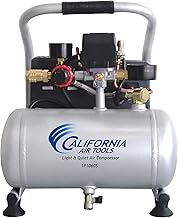
California Air Tools CAT-1P1060S
This one-gallon powerhouse tops our list for apartment dwellers and home office users who need occasional brad nailing or tire inflation without the racket. At just 56 dB, it’s quieter than a normal conversation, and the lightweight steel tank makes it genuinely portable. It won’t sustain a spray gun, but for trim work and quick inflation jobs it punches well above its weight.
Vevor 6.3 Gallon Air Compressor
If you need real air volume on a budget, the Vevor’s 6.3-gallon tank and 2 HP motor deliver 3.35 CFM at 90 PSI — enough to run most finish nailers and light spray guns without pausing. The oil-free design means less fuss, and the larger tank cuts duty cycle noise during longer projects. It’s bulkier than the others here, but for a home garage or workshop it’s the best value per cubic foot of air.
MZB 2.4 Gallon Ultra Quiet
Sitting between the ultra-portables and the full-size Vevor, the MZB strikes an appealing balance: 2.4 gallons of stored air at a whisper-quiet 70 dB, powered by a 1.2 HP motor. It handles spray painting, auto detail work, and finish nailing with ease. The mid-size tank keeps weight manageable while still offering enough reserve for sustained tasks that would overwhelm a one-gallon unit.
AstroAI L7 Tire Inflator
Fully cordless and small enough for a glove box, the AstroAI L7 runs on a rechargeable battery and inflates a standard car tire in under five minutes. The digital gauge and auto shut-off mean you don’t have to hover over the process, and the built-in LED light is genuinely useful for roadside emergencies after dark. For anyone who commutes or bikes regularly, this is the grab-and-go solution.
AstroAI AIRUN H Tire Inflator
Powered by your car’s 12V outlet with a generous 9.8-foot cord, the AIRUN H reaches every tire without repositioning your vehicle. It inflates steadily and the bright yellow housing is easy to spot in a cluttered trunk. It lacks the cordless freedom of the L7, but the unlimited run time from the cigarette lighter makes it a better pick for drivers who regularly maintain tire pressure across multiple vehicles.
Frequently Asked Questions
Can a small air compressor run power tools like a nail gun?
Yes, but it depends on the tool. Brad nailers and pin nailers typically need only 0.5–1 CFM at 90 PSI, so a one or two-gallon unit handles them fine. Heavier framing nailers and spray guns demand 3+ CFM continuously, which pushes you toward a larger tank like the Vevor 6.3 gallon.
What’s the difference between a tire inflator and an air compressor?
A tire inflator is designed specifically for pushing air into tires and small inflatables — it’s compact, portable, and rated for high PSI but low sustained airflow. A general-purpose air compressor stores a larger volume of air in a tank and can power pneumatic tools, making it more versatile for workshop tasks.
How loud are these budget compressors really?
Noise varies dramatically. The California Air Tools model runs at 56 dB, roughly the volume of a quiet office, while some unbranded units can exceed 90 dB — comparable to a lawnmower. Always check the dBA rating and consider where you’ll be using the compressor before buying.
Do I need an oil-free compressor for home use?
Oil-free is strongly recommended for most home users. You never have to change oil, the unit can be stored or operated at slight angles, and there’s no risk of oil leaking onto finished floors or furniture. Oil-lubricated models run a bit smoother and last longer under heavy use, but that benefit rarely matters for occasional home projects.
Final Thoughts
For most homeowners, the California Air Tools CAT-1P1060S offers the best blend of quiet operation and portability for everyday tasks. Step up to the Vevor 6.3 Gallon if you need enough air volume to power real tools in your garage, and grab the AstroAI L7 as a compact emergency inflator that lives in your trunk. All three hold their own against pricier competition and cover the most common scenarios you’ll encounter around the house.