Key takeaways
- Tooth Count: Higher tooth counts (60–80T) produce smoother crosscuts and cleaner plywood edges, while lower counts (40T) cut faster but leave more tear-out. Many woodworkers keep two blades on hand — one for ripping, one for finish cuts.
- Tooth Geometry: Alternate top bevel (ATB) teeth score fibers from alternating sides, which is the gold standard for plywood. A high ATB angle (15°+) handles veneered panels and laminate with fewer chips than a flat-top grind.
- Kerf Width: Thin-kerf blades remove less material and demand less horsepower, which matters on contractor saws with 1½ HP motors. Full-kerf blades resist deflection better but put more strain on your fence alignment.
- Arbor Size: Most benchtop and jobsite saws accept 5/8″ arbors, but some larger cabinet saws run on 1″ bores. Always measure before ordering — an adapter ring works in a pinch but can introduce runout.
- Blade Diameter: A 10″ blade covers the vast majority of table saws and miter saws in home shops. The occasional 9″ blade fits compact saws, while 12″ blades suit larger sliding miter saws and require a saw designed for that diameter.
What's inside
If you’ve ever run a sheet of plywood through your table saw and ended up with edges that look chewed rather than cut, you already know the problem. A dull or mismatched blade tears out veneer, leaves fuzzy edges on melamine, and turns what should be a clean afternoon project into hours of sanding and edge-banding. Choosing the right blade for plywood is less about brand loyalty and more about understanding tooth geometry, kerf width, and how those specs interact with your saw’s motor.
This guide narrows the field to six blades currently worth your money. We looked at cut quality on hardwood plywood and MDF, how the blade handles both ripping and crosscutting, noise during operation, and long-term durability of the carbide tips. Whether you’re breaking down sheet goods for cabinet carcasses or trimming edge-banded panels to final width, there’s a match in here that will noticeably improve your results.
As an Amazon Associate we earn from qualifying purchases.


How to Choose a Plywood Table Saw Blade (2026)
- Tooth Count: Higher tooth counts (60–80T) produce smoother crosscuts and cleaner plywood edges, while lower counts (40T) cut faster but leave more tear-out. Many woodworkers keep two blades on hand — one for ripping, one for finish cuts.
- Tooth Geometry: Alternate top bevel (ATB) teeth score fibers from alternating sides, which is the gold standard for plywood. A high ATB angle (15°+) handles veneered panels and laminate with fewer chips than a flat-top grind.
- Kerf Width: Thin-kerf blades remove less material and demand less horsepower, which matters on contractor saws with 1½ HP motors. Full-kerf blades resist deflection better but put more strain on your fence alignment.
- Arbor Size: Most benchtop and jobsite saws accept 5/8″ arbors, but some larger cabinet saws run on 1″ bores. Always measure before ordering — an adapter ring works in a pinch but can introduce runout.
- Blade Diameter: A 10″ blade covers the vast majority of table saws and miter saws in home shops. The occasional 9″ blade fits compact saws, while 12″ blades suit larger sliding miter saws and require a saw designed for that diameter.
The Best Plywood Table Saw Blade (2026)s Reviewed
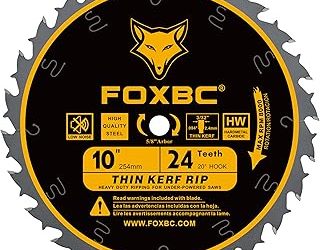
FOXBC 10-Inch 80-Tooth Ultra Finish
The FOXBC 80T delivers impressively clean plywood cuts at a price that undercuts most name-brand finish blades. Its thin kerf design is easy on underpowered saws, and the ATB grind leaves a surface smooth enough that veneer edge-banding sticks without additional sanding. It’s an outstanding value pick for anyone who wants finish-grade results without paying cabinet-shop prices.
S55300 (XL4000) 12-Inch 60T Combo
This 12-inch combo blade bridges the gap between ripping and crosscutting in a single pass. The 60T count and modified ATB geometry handle plywood, hardwood, and softwood without constant blade swaps — a genuine convenience if your shop is tight on space or your saw takes a long time to change blades. It’s best suited to larger saws with the motor headroom to push through 12 inches of cut efficiently.
KENDO 10-Inch 2-Pack (40T/60T)
Buying a two-blade set is the pragmatic move for woodworkers who don’t want to compromise. The 40T rips through plywood and solid lumber with authority, while the 60T handles finish crosscuts and delicate veneer work. Both blades share a standard 5/8″ arbor, so swapping between them is a two-minute task. For the price of a single mid-range blade elsewhere, KENDO gives you a versatile two-blade system.
WORKPRO 10-Inch 80T Ultra Fine Finish
The WORKPRO 80T targets cabinetry and trim work where surface quality directly affects your finishing time. Its thin-kerf carbide tips stay sharp through extended use, and the blade runs noticeably quieter than many budget 80-tooth options. If your primary workload is crosscutting plywood and MDF panels for cabinet parts, this blade earns its place on your arbor.
10-Inch 80T 1-Inch Big Arbor Blade
Designed for saws that use the larger 1-inch arbor, this 80-tooth blade eliminates the wobble that adapter rings sometimes introduce. The tungsten carbide ATB teeth deliver ultra-fine finishes across hardwoods, softwoods, plywood, and MDF. If you run a cabinet saw with a 1″ bore, this is one of the few finish blades built specifically for that setup — no modifications required.
Frequently Asked Questions
Can I use one blade for both ripping and crosscutting plywood?
A 60T ATB blade does an acceptable job at both tasks, though it won’t be as fast as a dedicated 40T rip blade or as smooth as an 80T finish blade. If you value convenience over peak performance, a mid-range combo blade keeps you swapping less often while still producing clean cuts on sheet goods.
What causes tear-out on the plywood surface?
Tear-out happens when teeth strike the veneer from the wrong side or when the blade is dull, wobbling, or the wrong type for the material. An ATB grind with sharp carbide tips and a zero-clearance insert dramatically reduce both the top and bottom face chipping.
Does a thin-kerf blade cut as well as a full-kerf blade?
For plywood, thin kerf often cuts better because it creates less resistance and heat, which means less burning and less tear-out. The main trade-off is that thin kerf blades flex more under heavy rip cuts in thick hardwood, but for plywood panels up to ¾ inch, thin kerf is perfectly adequate and often preferred.
How often should I replace my plywood saw blade?
With regular use on plywood and MDF — both of which contain abrasive glues — expect a quality carbide blade to stay sharp for roughly 100 to 200 hours of cutting. Signs it’s time include increased burning, requiring more feed pressure, and visible dulling on the carbide tips. Keeping the blade clean with pitch remover extends its life significantly.
Final Thoughts
For most home-shop woodworkers cutting plywood, the FOXBC 80T offers the best balance of cut quality and value, and the KENDO 2-pack is the smartest buy if you want both a rip and finish blade without stretching your budget. If you own a cabinet saw with a 1-inch arbor, the dedicated 80T big-arbor blade solves a compatibility headache that most reviewers overlook. Match the blade to your saw and your workload, and plywood will start looking less like a compromise material and more like the versatile, good-looking stock it’s meant to be.