Key takeaways
- Port Size and Airflow: Match the NPT fitting size to your compressor’s output line. A 3/8″ unit suits small compressors and single tools, while 1/2″ and 3/4″ fittings handle higher CFM demands without choking airflow or introducing pressure drops.
- Stage Count and Filtration Depth: More stages generally mean finer moisture and contaminant removal. A single-stage filter catches bulk water; two or three stages add particulate and coalescing filtration; a fourth stage with desiccant can deliver near-instrument-grade dryness for sensitive work.
- Drain Type: Auto-drain models purge condensation continuously without manual intervention — essential for extended sessions. Semi-auto drains require periodic button presses but cost less. Manual bowl drains work only if you remember to use them every time.
- Bowl Material and Durability: Metal bowls withstand shop abuse, heat, and accidental impacts far better than plastic alternatives. If your setup lives in a busy garage or job site, metal is worth the modest premium.
- Integrated Regulator: Some separators include a built-in pressure regulator (typically 0–240 PSI). This saves a fitting, reduces leak points, and gives you fine-tuned control at the point of use rather than back at the compressor tank.
What's inside
Moisture inside a compressed air line is the silent enemy of quality finishes, reliable tool operation, and expensive equipment longevity. Whether you’re laying down a flawless automotive clear coat, running a plasma cutter, or powering pneumatic nailers in the workshop, water vapor sneaking past your compressor will cause splotchy paint, premature rust, and inconsistent air pressure. The frustrating part? Most compressor owners don’t realize how much condensation they’re dealing with until the damage is already visible — streaky finishes, sticky regulator valves, or tools that just don’t perform like they used to.
This roundup cuts through the confusion and narrows the field to six standout air compressor water separators worth your attention in 2026. Each one targets a slightly different setup — from compact one-gun hobby rigs to full-blown industrial multi-tool systems — so you can match the right dryer to your actual workload without overpaying for capacity you’ll never use.
As an Amazon Associate we earn from qualifying purchases.




How to Choose an Air Compressor Water Separator (2026)
- Port Size and Airflow: Match the NPT fitting size to your compressor’s output line. A 3/8″ unit suits small compressors and single tools, while 1/2″ and 3/4″ fittings handle higher CFM demands without choking airflow or introducing pressure drops.
- Stage Count and Filtration Depth: More stages generally mean finer moisture and contaminant removal. A single-stage filter catches bulk water; two or three stages add particulate and coalescing filtration; a fourth stage with desiccant can deliver near-instrument-grade dryness for sensitive work.
- Drain Type: Auto-drain models purge condensation continuously without manual intervention — essential for extended sessions. Semi-auto drains require periodic button presses but cost less. Manual bowl drains work only if you remember to use them every time.
- Bowl Material and Durability: Metal bowls withstand shop abuse, heat, and accidental impacts far better than plastic alternatives. If your setup lives in a busy garage or job site, metal is worth the modest premium.
- Integrated Regulator: Some separators include a built-in pressure regulator (typically 0–240 PSI). This saves a fitting, reduces leak points, and gives you fine-tuned control at the point of use rather than back at the compressor tank.
The Best Air Compressor Water Separators (2026) Reviewed
3/4″ NPT 4-Stage Industrial Air Drying System
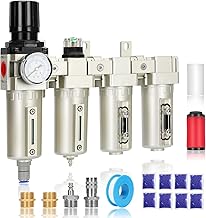
This is the heaviest hitter in the lineup and the one I’d point a serious workshop toward without hesitation. With a 3/4″ NPT port and four full stages of air drying — including an oil-water separator designed specifically for sandblasting and spray painting — it handles high-CFM setups that would overwhelm smaller units. The auto drain keeps things maintenance-free during long jobs, and the industrial build quality suggests this is a buy-once component.
1/2″ NPT 3-Stage Air Drying System with Metal Bowl
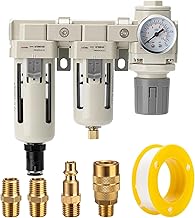
A genuinely well-rounded mid-tier option that punches above its price bracket. The combination of a particulate filter, coalescing filter, and desiccant dryer gives you three layers of protection in a compact metal-bodied unit. The included 0–240 PSI regulator means you can fine-tune output pressure right at the tool, and the auto drain eliminates the forgetting problem that plagues manual-drain setups. Solid choice for most home shops.
3/8″ NPT Air Filter Dryer with Double Filters
Compact and budget-conscious without being disposable. The dual-filter design pairs with a pressure regulator covering 0–150 PSI, and the unique dual-drain option — auto and semi-auto — gives you flexibility depending on how long you’re running. The 3/8″ port limits it to lighter-duty applications, but for a single paint gun or finish nailer it delivers surprisingly clean, dry air at a fraction of the cost of larger systems.
LE LEMATEC 1/4″ NPT Inline Air Filter (AI303)
LE LEMATEC is a name that shows up in virtually every pneumatic accessory conversation, and the AI303 earns that visibility. At just 1/4″ NPT, it’s designed for inline placement right before the tool — perfect for plasma cutters, paint guns, or any application where dry air at the point of delivery matters most. The auto-draining pneumatic dryer handles moisture removal passively, making it an effortless add-on for anyone running a dedicated line to a single high-precision tool.
1/2″ NPT 4-Stage Air Dryer, 141 CFM
This unit shares the four-stage architecture of its larger 3/4″ sibling but in a more versatile 1/2″ NPT body, with a published 141 CFM flow rate that comfortably covers multiple tools. It’s purpose-built for demanding tasks like plasma cutting and professional spray painting where even trace moisture ruins results. The auto drain and industrial-grade construction round out a package that sits right at the intersection of serious performance and broad compatibility.
Frequently Asked Questions
Where should I install the water separator in my air line?
Mount it as close to the point of use as practical, or directly downstream of the compressor tank. Separators installed near the tank catch condensation before it travels through long hose runs; point-of-use units add a final protection stage. Many shops use both for maximum dryness.
Can a water separator eliminate all moisture from compressed air?
No single separator removes every trace of moisture, especially under high-humidity conditions. Multi-stage systems with desiccant elements come closest, but pairing a quality separator with proper tank draining and, in critical applications, an additional desiccant cartridge gives the best results.
Do I need an auto-drain or is manual draining enough?
Manual drains work fine for short, infrequent sessions where you remember to purge the bowl after each use. For anything longer or in a multi-user shop, auto-drain eliminates human error and prevents the bowl from filling up mid-job — a common cause of water passing straight downstream into your tools.
How often should I replace the filters inside the separator?
Most manufacturers recommend inspecting filter elements every 500–1,000 operating hours, though dusty or high-humidity environments can shorten that window considerably. A clogged filter restricts airflow, drops pressure, and reduces drying efficiency, so visual inspection and periodic replacement pay for themselves quickly.
Final Thoughts
For the majority of home shop owners, the 1/2″ NPT 3-Stage System with Metal Bowl strikes the best balance of filtration depth, build quality, and everyday convenience. Workshops running higher CFM or multiple simultaneous tools should look at the 3/4″ NPT 4-Stage Industrial System for uncompromised performance. And if you simply need reliable dry air feeding a single precision tool, the LE LEMATEC AI303 delivers exactly that in a compact, no-fuss package.