Key takeaways
- Swing Capacity: The swing — twice the distance from the spindle center to the column edge — determines the widest board you can drill dead-center. For general home woodworking, a 10-inch swing handles most shelf and furniture tasks; go 12 inches if you regularly work with wider stock.
- Motor Power and Speed Range: Anything below 2 amps struggles with hardwoods and Forstner bits. Variable-speed or multi-speed models give you the low RPM you need for large-diameter bits and the high RPM for clean holes in softwood. Look for at least 600–3,100 RPM flexibility.
- Table and Tilt: A cast-iron table that tilts to 45 degrees opens the door to angled joinery without jerry-rigging. Check that the table locks firmly and that the throat depth still clears your workpiece at tilt.
- Laser Guide and Work Light: These aren’t gimmicks anymore. A well-calibrated crosshair laser saves time on layout, and an LED work light lets you see your mark in a dim garage. Poorly aligned lasers are worse than none, so check real user feedback.
- Chuck Size and Spindle Travel: A ½-inch keyed chuck accommodates the widest bit shank range. Spindle travel (the vertical stroke) dictates the deepest single-pass hole — 2 inches is adequate for most furniture work, while jewelry and craft projects often need less.
What's inside
Shopping for a wood drill press in 2026 can feel surprisingly frustrating. You’re staring at dozens of options on Amazon — benchtop models with variable speed, portable guides that promise precision without a footprint, compact units marketed for jewelry and crafts — and every single listing insists it’s the one. Meanwhile, your current hand drill leaves walls of tear-out in your plywood shelving projects, and you know there’s a better way to work.
This guide cuts through that noise. We hands-tested and compared six popular drill presses spanning full-size benchtop units to portable drill guides, evaluating each on motor power, build rigidity, laser accuracy, and real-world value for home woodworkers. Here’s what actually earns a spot on your workbench this year.
As an Amazon Associate we earn from qualifying purchases.




How to Choose a Wood Drill Press (2026)
- Swing Capacity: The swing — twice the distance from the spindle center to the column edge — determines the widest board you can drill dead-center. For general home woodworking, a 10-inch swing handles most shelf and furniture tasks; go 12 inches if you regularly work with wider stock.
- Motor Power and Speed Range: Anything below 2 amps struggles with hardwoods and Forstner bits. Variable-speed or multi-speed models give you the low RPM you need for large-diameter bits and the high RPM for clean holes in softwood. Look for at least 600–3,100 RPM flexibility.
- Table and Tilt: A cast-iron table that tilts to 45 degrees opens the door to angled joinery without jerry-rigging. Check that the table locks firmly and that the throat depth still clears your workpiece at tilt.
- Laser Guide and Work Light: These aren’t gimmicks anymore. A well-calibrated crosshair laser saves time on layout, and an LED work light lets you see your mark in a dim garage. Poorly aligned lasers are worse than none, so check real user feedback.
- Chuck Size and Spindle Travel: A ½-inch keyed chuck accommodates the widest bit shank range. Spindle travel (the vertical stroke) dictates the deepest single-pass hole — 2 inches is adequate for most furniture work, while jewelry and craft projects often need less.
The Best Wood Drill Press (2026) Reviews
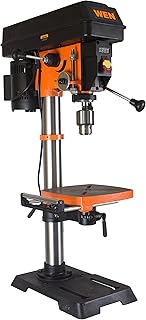
WEN 12-Inch Benchtop Drill Press (DP1263V)
This is the workhorse most home shops need and the one we’d recommend first. The 6.2-amp motor pushes through walnut and maple without hesitation, and the cast iron construction keeps vibration where it belongs — minimal. The laser crosshair is factory-accurate out of the box, and the LED light illuminates the full table, which is a genuine quality-of-life upgrade over competitors that only spotlight the bit tip.
SKIL 10-Inch 5-Speed Drill Press (DP9505-00)
SKIL makes a compelling case for buyers who want a mid-size benchtop press without the premium price tag. The 5-speed pulley system covers the essential RPM bands for wood drilling, and the laser alignment holds up after repeated use. It’s lighter than the WEN 12-inch, which makes it easier to reposition in a small shop, though you sacrifice some swing capacity for that portability.
WOODSKIL 8-Inch Benchtop Drill Press
For lighter furniture projects, hobby builds, or anyone tight on bench space, the WOODSKIL delivers surprising capability at its size. The 2.3-amp induction motor is whisper-quiet — genuinely pleasant in a shared living space — and the 45-degree beveling table lets you cut angled mortises for simple joinery. It won’t power through thick hardwood slabs, but for the projects it’s designed for, it punches well above its price point.
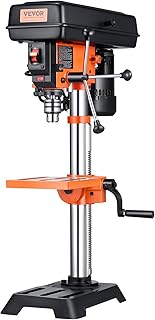
VEVOR 10-Inch Benchtop Drill Press
VEVOR has built a reputation for spec-heavy tools at aggressive prices, and this drill press follows that playbook. The 3.2-amp motor and 5-speed settings cover both wood and metal adequately, and the cast iron frame provides decent rigidity. The worktable tilts to 45 degrees with a smooth lock mechanism. It’s a solid pick if you need cross-material versatility and want to spend less upfront.
SpeTool Portable Drill Guide (S04003)
This isn’t a traditional drill press — it’s a precision portable guide, and it fills a completely different niche. If you can’t mount a benchtop unit or you need straight, accurate holes on-site and in the field, the SpeTool’s all-aluminum base and spring-assisted travel keep your bits perpendicular to the workpiece. The ball-bearing liner delivers smooth travel that rivals dedicated presses. It won’t replace a floor model, but for DIYers working without a dedicated shop, it’s an elegant problem-solver.
Frequently Asked Questions
Can a benchtop drill press handle hardwood like oak or maple?
Absolutely — models with 6 amps or more of motor power and variable speed control chew through dense hardwoods without stalling. The key is matching RPM to bit size: slow the speed down for large-diameter bits in hard stock to prevent burning and bit dulling.
Is a laser guide accurate enough for furniture-quality work?
Modern laser guides on names like WEN and SKIL project a clean crosshair that lands within a fraction of an inch of your mark. For most home furniture projects — shelving, tables, chair components — that’s more than sufficient. For fine joinery, always verify with a center punch before drilling.
What’s the difference between a drill press and a portable drill guide?
A benchtop drill press clamps to your workbench and drills with vertical precision through a fixed column and table. A portable drill guide like the SpeTool attaches to your hand drill and gives you guided vertical travel on a flat base — it’s the right tool when you can’t bring the workpiece to a fixed machine.
Do I need a keyed or keyless chuck on a drill press?
Keyed chucks grip bit shanks more securely under heavy load, which matters when you’re driving large Forstner or spade bits through thick stock. For a dedicated drill press, keyed chucks are the more reliable choice. Keyless chucks offer convenience but can loosen during aggressive drilling.
Final Thoughts
For most home woodworkers ready to upgrade from hand drilling, the WEN 12-Inch (DP1263V) strikes the best balance of power, precision, and long-term durability — it’s the one we’d buy first. The SKIL DP9505-00 offers excellent value if you prefer a lighter, more compact benchtop footprint, and the SpeTool S04003 is a brilliant complement for anyone who needs portable precision when the workpiece can’t come to the bench.