Key takeaways
- Leave a small, intentional expansion gap around fixed walls or cabinets if the manufacturer recommends it.
- Keep a scrap of roll material or a few spare tiles for future repairs and color matching.
- Use wide boards beneath jack stands or heavy point loads unless the flooring maker specifically approves direct contact.
- Test a cleaning product in an inconspicuous area before using it across the garage.
What's inside
The best garage flooring does more than make a concrete slab look finished. It can reduce dust, soften footfall, protect against dropped tools, and make oil or road salt much easier to manage. The right choice also improves everyday comfort: a floor that drains well or cleans quickly is far less frustrating during wet, messy seasons.
This guide compares the main garage-flooring formats—interlocking tiles, PVC rolls, and absorbent parking mats—so you can match the surface to your climate, vehicle use, and budget. It also covers installation, load ratings, drainage, cleaning, and the details that matter after the first week of use.
As an Amazon Associate we earn from qualifying purchases.




Start with the garage’s main job
Before shopping, decide whether the garage is primarily a parking bay, workshop, storage room, gym, or a mixture of all four. A car-only space may benefit most from a large protective mat, while a workshop usually needs a continuous, easy-clean surface. If you regularly work on vehicles, expect spilled fluids and rolling jacks; if the garage doubles as a recreation space, comfort and appearance may matter more than maximum load capacity.
Also inspect the concrete. Small cracks and surface discoloration are usually manageable, but significant moisture, crumbling concrete, or an uneven slab should be addressed first. Flooring can hide cosmetic flaws, but it will not solve a drainage or structural problem.
Choose between tiles, rolls, and mats
Interlocking tiles are a flexible option for garages where access to the concrete may still be needed. Individual sections can be lifted or replaced, and installation normally requires no adhesive. Plastic tiles also create a slight separation from the slab, which can help with airflow and, in open-grid designs, drainage. The trade-off is that they may transmit more impact noise and can collect grit underneath.
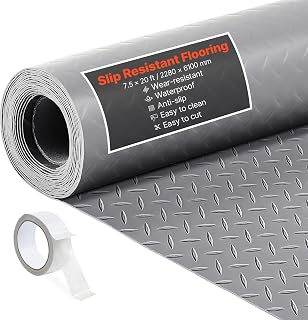
Roll flooring gives the most continuous appearance and leaves fewer seams for dirt to enter. PVC diamond-plate rolls such as the VEVOR Garage Floor Roll are practical for broad coverage and straightforward sweeping. Rolls can be heavy to position, may need time to flatten, and require careful trimming around walls, posts, and door tracks.
Parking mats are the simplest targeted solution. An oversized product such as the Garage Mats Oversize Garage Floor Parking Mat can catch water, mud, and oil beneath a vehicle without covering the whole room. It is a good fit when the rest of the slab is sound and you want low-commitment protection rather than a complete floor makeover.
Check load capacity and surface performance
Do not judge a garage floor by its appearance alone. Look for a stated rolling-load capacity if you will drive across it, use a floor jack, or move a loaded tool chest. The Garage Floor Tiles Interlocking Garage Flooring for Car Modular PlasticTile are marketed with a 40,000-pound load capacity, while SnapLock RaceDeck Free-Flow tiles list an 80,000-pound rolling load capacity. Those figures are useful comparisons, but they do not mean every point load is harmless: narrow jack wheels, stands, and damaged casters concentrate weight.
Surface texture is another practical consideration. A pronounced pattern can improve traction when wet, but it may be harder to sweep than a flatter finish. Open-grid tiles such as SnapLock RaceDeck Free-Flow allow water to pass through and can suit damp climates, provided the slab beneath can handle drainage. Solid rolls are easier to mop and better at containing small spills on the surface.
Measure carefully and plan the installation
Measure the usable floor area—not just the wall-to-wall dimensions—and note door swings, steps, floor drains, cabinets, and permanent equipment. For tile systems, calculate the number of tiles needed after accounting for cuts around edges. Larger tiles can speed installation, but smaller modules may make awkward corners easier to finish. Swisstrax Ribtrax PRO tiles measure 15.75 inches square, so their layout will differ noticeably from standard 12-by-12-inch tiles.
Clean and dry the slab thoroughly before installation. Remove loose paint, grit, and grease, then allow the floor to dry fully. Tiles usually snap together starting from a straight reference line. Rolls should be unrolled in the intended direction, allowed to relax, and trimmed with a sharp utility knife. Double-sided tape, including the supplied tape with the 8×20 FT Garage Floor Mat, can help control movement, but follow the manufacturer’s guidance and avoid trapping moisture.
Match the material to climate and maintenance
Cold temperatures can make some materials less flexible, while strong sunlight through an open garage door may affect color over time. Water, road salt, and melting snow are especially important in northern climates. A self-draining tile system can be easier to live with when water regularly enters beneath a vehicle, whereas an absorbent mat may need to be lifted and dried periodically.
For routine care, sweep sand and grit before they scratch the surface, wipe spills promptly, and use a mild cleaner compatible with the flooring. Avoid assuming that “oil resistant” means permanently stain-proof. Check seams and edges occasionally, especially where a vehicle’s tires repeatedly turn, and replace damaged tiles or worn tape before they become trip hazards.
Tips
- Leave a small, intentional expansion gap around fixed walls or cabinets if the manufacturer recommends it.
- Keep a scrap of roll material or a few spare tiles for future repairs and color matching.
- Use wide boards beneath jack stands or heavy point loads unless the flooring maker specifically approves direct contact.
- Test a cleaning product in an inconspicuous area before using it across the garage.
Frequently Asked Questions
What is the most durable garage flooring?
Commercial-grade polypropylene tiles and heavy PVC flooring are among the most durable residential choices. Durability depends on more than thickness: load distribution, installation quality, sunlight, chemicals, and the condition of the concrete all matter. Choose a product with a published rolling-load rating when vehicles or equipment will cross it frequently.
Are garage floor tiles better than a roll?
Neither format is universally better. Tiles are easier to repair, can provide drainage, and avoid adhesive in many installations. Rolls create fewer seams and are often simpler to sweep and mop. Choose tiles for flexibility and drainage; choose a roll for broad, continuous coverage and spill management.
Can garage flooring go over cracked concrete?
It can cover minor cosmetic cracks, but first remove loose material and make sure the slab is dry and stable. Significant movement, dampness, or uneven areas can telegraph through the flooring or prevent tiles from locking properly. Repair underlying problems before investing in a finished surface.
What is the easiest garage flooring to install?
A parking mat requires the least work, while snap-together tiles are generally the easiest full-floor solution for a reasonably square room. Rolls are also uncomplicated once positioned, but their weight makes alignment and trimming more demanding. A second person is helpful for large mats and rolls.
Conclusion
The best garage flooring for 2026 is the one that fits how you actually use the space. Pick interlocking tiles for modular installation and drainage, a PVC roll for continuous easy-clean coverage, or an oversized mat for focused vehicle protection. Measure twice, prepare the slab, and prioritize load handling, moisture control, and maintenance over appearance alone; those choices will determine whether the floor remains useful and comfortable for years.