Key takeaways
- Switch off the circuit and verify it is dead before working near electrical components; do not rely on the wall switch alone.
- Set a step ladder fully open with its spreaders locked, and keep all four feet planted on a firm, level surface.
- Face the ladder while climbing and keep your belt buckle between the side rails; climb down and reposition instead of reaching.
- Use fiberglass ladders clean and dry, and keep them away from overhead lines, even when the task does not appear electrical.
What's inside
Choosing a ladder for electrical work is less about reaching the highest point and more about controlling risk in an awkward environment. A ladder may be near wiring, panels, light fittings, or tools that conduct electricity, so the right material, stance, size, and stability all matter. Fiberglass is generally the preferred ladder material because it is non-conductive, but it is not a substitute for switching off power or following electrical-safety procedures.
This guide explains which ladder styles work best for common household jobs, how to choose the correct height and duty rating, and what to check before climbing. The recommendations are aimed at practical home maintenance, from changing a ceiling fixture to inspecting an outdoor fitting, with comfort and everyday usability considered alongside safety.
As an Amazon Associate we earn from qualifying purchases.


Our Recommended Picks
For straightforward indoor jobs, an eight-foot fiberglass step ladder is often the most useful choice. The Louisville Ladder FS1508 Ladder, 8-Foot, Orange is a sensible general-purpose format: tall enough for many ceilings without the bulk of an extension ladder. If you need a higher working position but still want an A-frame setup, the Little Giant Ladder Systems Dark Horse 2.0, M17, 17ft offers multiple configurations and non-conductive fiberglass construction. Its size is valuable outdoors, though it demands more room and careful setup.
For buyers prioritizing a high load rating, the 8-FT Fiberglass Step Ladder, 500 lb Capacity and the Fiberglass Ladder, 500 lbs Load Capacity, 5-Foot provide wide steps and non-slip feet in two useful heights. The Soctone A Frame Extension Ladder, 14 Ft adds multi-position flexibility and a stabilizer bar for household or outdoor tasks. For a conventional extension-ladder layout, consider the Louisville Ladder 16-foot Fiberglass Extension Ladder, FE3216. Use the cards above to compare the available models, but always verify the current specifications and certification label before purchase.
Choose Fiberglass for Electrical Work
Fiberglass is the usual recommendation when a ladder could be exposed to electrical hazards because it does not conduct electricity in the same way as aluminum. That said, “non-conductive” does not mean electrically safe under every condition. Wet surfaces, damaged rails, contamination, metal hardware, and contact with energized equipment can still create serious danger. Turn off the relevant circuit at the breaker, confirm that power is absent with an appropriate tester, and hire a qualified electrician when the task involves uncertain wiring or energized equipment.
Inspect the rails, steps, feet, spreaders, and locking hardware before every use. Retire a ladder with cracks, deep gouges, loose rivets, bent components, or badly worn feet; tape and improvised repairs are not reliable fixes.
Match the Ladder Style to the Job
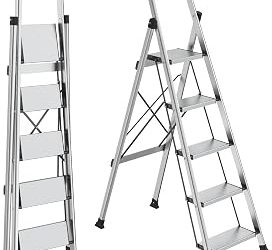
A step ladder is usually the most comfortable option indoors. Its self-supporting A-frame design lets you work without leaning against a wall, and broad steps are easier on your feet during a task that takes more than a few minutes. Choose one that lets you work without standing on the top step or top cap. An eight-foot model suits many standard-height rooms, while a five-foot ladder can be easier to move for lower fixtures, cupboards, and stair-free maintenance.
An extension ladder is better for exterior lights, high gables, and locations where an A-frame cannot be opened. It must rest on a sound surface and be placed at the correct angle, with the upper section secured against movement. A multi-position ladder can switch between step, extension, and other configurations, but versatility increases the number of hinges and locks to check. Set it up only in a configuration expressly permitted by its instructions.
Get the Height and Reach Right
Do not select a ladder based solely on its advertised length. A 16-foot extension ladder does not provide a 16-foot standing height, and safe use requires keeping your body below the highest permitted step. For a step ladder, measure the height of the work area and leave room for a balanced stance. If you must stretch, lean sideways, or stand on an unsafe rung, the ladder is effectively too short.
Also account for storage and transport. A tall extension ladder can be difficult to carry through a hallway or position around furniture, while a compact step ladder may be used more often because it is easy to retrieve. For most homeowners, the best ladder is the one that reaches the job safely without becoming unwieldy.
Check Capacity, Stability, and Comfort
The duty rating must cover your body weight, clothing, shoes, tools, and materials. A 300-pound Type IA rating is suitable for many demanding household tasks, while 500-pound models offer extra margin for heavier users or equipment. Do not confuse capacity with permission to carry bulky loads; use a tool belt or hoist small items rather than climbing with both hands occupied.
Look for wide, slip-resistant steps, firm rubber feet, a sturdy spreader, and clear locking indicators. On uneven outdoor ground, never level a ladder with loose blocks or improvised packing. Relocate it or use equipment designed for that surface. Keep the base clear of rugs, cords, wet patches, and open doors.
Tips
- Switch off the circuit and verify it is dead before working near electrical components; do not rely on the wall switch alone.
- Set a step ladder fully open with its spreaders locked, and keep all four feet planted on a firm, level surface.
- Face the ladder while climbing and keep your belt buckle between the side rails; climb down and reposition instead of reaching.
- Use fiberglass ladders clean and dry, and keep them away from overhead lines, even when the task does not appear electrical.
Frequently Asked Questions
Is fiberglass or aluminum better for electrical work?
Fiberglass is the better choice because it is non-conductive under normal conditions. Aluminum conducts electricity and should not be used where contact with energized wiring or equipment is possible. Neither material makes it safe to work on a live circuit.
What size ladder is best for changing ceiling lights?
For many homes, a five- to eight-foot fiberglass step ladder is practical. Choose the shortest model that lets you reach the fixture while standing below the manufacturer’s highest safe step. A ladder that is too tall for the room can be harder to position securely.
Can I use a multi-position ladder indoors?
Yes, provided the floor is level and the ladder is configured exactly as directed. Multi-position models are useful when one ladder must handle several jobs, but their hinges and locks require careful inspection. Avoid using an extension configuration in a confined room where the ladder cannot be stabilized.
When should I hire an electrician instead?
Hire a qualified electrician for exposed or damaged wiring, unknown circuits, service-panel work, overhead-line hazards, persistent tripping, or any situation where power cannot be positively isolated. A ladder helps you reach the work; it does not remove the electrical hazard.
Conclusion
For most household electrical-access jobs, a fiberglass step ladder with broad steps, secure feet, and an appropriate duty rating is the most comfortable and controllable choice. Move to a multi-position or extension model only when the height or location genuinely requires it. Select conservatively, inspect every time, and treat de-energizing the circuit and maintaining a stable stance as essential parts of the equipment—not optional extras.