Key takeaways
- Potentially more comfortable operation during sleep.
- Reduced-speed settings for quiet activities.
- Convenient nighttime controls on suitable models.
- Better compatibility with noise-sensitive routines.
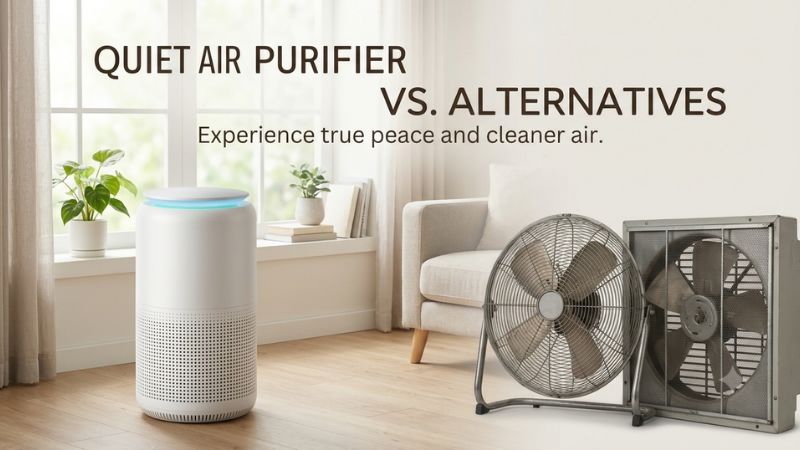
Comparing a quiet air purifier vs alternatives helps determine which household appliance or air quality strategy best addresses your needs. Portable filtration, central HVAC filters, ventilation, fans, and dehumidifiers perform different functions. Understanding their advantages, limitations, noise characteristics, and ownership costs makes choosing the right solution easier.
Quick Comparison
A quiet portable air purifier is generally a practical choice when dedicated particle filtration is needed in a bedroom, home office, or other noise-sensitive room.
However, other solutions may provide broader household coverage, greater airflow, more affordable filtration, or better control of specific environmental problems.
| Solution | Main Function | Noise Characteristics | Main Advantage | Main Limitation |
|---|---|---|---|---|
| Quiet portable purifier | Particle filtration | Reduced-speed operating options | Comfortable room-level operation | Lower airflow at reduced speeds |
| Standard purifier | Particle filtration | Depends on fan setting | Potentially greater capacity per dollar | Strong settings may be distracting |
| HVAC filtration | Central particle filtration | Equipment and duct sounds | Potential whole-home coverage | Requires compatible equipment |
| DIY air cleaner | Particle filtration | Depends on fan and construction | Potentially economical capacity | Variable performance |
| Exhaust ventilation | Source pollutant removal | Fan and duct noise | Removes pollutants near their source | Installation requirements |
| Window ventilation | Outdoor air exchange | Depends on outdoor conditions | Helps reduce indoor CO₂ buildup | May introduce outdoor particles |
| Conventional fan | Air circulation | Fan and motor sounds | Improves perceived cooling | No dedicated particle removal |
| Dehumidifier | Moisture reduction | Fan and possible compressor sounds | Addresses high humidity | Not a dedicated particle purifier |
These solutions should not be treated as directly interchangeable because they address different household requirements.
Understanding the Main Differences
What Defines a Quiet Air Purifier?
A quiet air purifier is a portable filtration appliance intended to provide useful particle removal while limiting disruptive operating noise.
Most residential models use a fan to draw room air through filtration media before returning it to the occupied environment.
Quiet operation may result from reduced fan speeds, efficient airflow design, cabinet engineering, or vibration management.
There is no universal decibel threshold that distinguishes every quiet purifier from every conventional model.
The relevant question is how much clean air the appliance provides at an operating sound level occupants can comfortably tolerate.
What Defines a Conventional Air Purifier?
A conventional purifier performs the same fundamental particle filtration function.
It may include multiple fan settings, automatic controls, and dedicated sleep functionality even when quiet operation is not its primary marketing emphasis.
Some conventional appliances may offer greater airflow for their purchase price, while others may provide comparable acoustic comfort at reduced speeds.
The distinction should therefore be based on actual operating characteristics rather than product naming.
What Are Air Purifier Alternatives?
Alternatives include central HVAC filtration, DIY filtered fans, ventilation, conventional fans, and moisture-control appliances.
Some provide particle filtration, while others address indoor gases, air movement, temperature comfort, or humidity.
An alternative is useful only when its primary function matches the household’s actual problem.
For example, a dehumidifier may be highly effective for excessive indoor moisture but is not an equivalent replacement for a dedicated particle purifier.
Quiet Air Purifier vs Alternatives: Technical Comparison
Particle Removal Capacity
Portable particle purifiers remove suspended particles by repeatedly moving air through filtration media.
Central HVAC systems may perform a similar function when equipped with compatible filters and operated sufficiently.
DIY air cleaners combine suitable fans and filtration components to provide particle removal.
Ordinary fans, ventilation systems, and dehumidifiers have different primary functions.
Ventilation can remove indoor air and its associated pollutants, but it may also introduce particles from outdoors when incoming air is unfiltered.
Airflow and Clean Air Delivery
Clean air delivery rate describes how much effectively particle-filtered air a portable purifier delivers over time.
For a room measuring 200 square feet with an 8-foot ceiling, the following hypothetical clean air delivery rates illustrate different equivalent air-change levels:
| Effective Clean Air Delivery | Approximate Equivalent ACH |
|---|---|
| 50 CFM | 1.9 |
| 100 CFM | 3.75 |
| 150 CFM | 5.6 |
| 200 CFM | 7.5 |
| 250 CFM | 9.4 |
These calculations assume reasonably mixed room air.
They do not establish measured performance for particular appliances.
A quiet purifier operating at a low speed may provide less effective clean air delivery than a conventional purifier running at a stronger setting.
Noise Characteristics
Portable purifiers primarily produce fan, motor, and airflow sounds.
Central HVAC systems may generate equipment noise, duct vibration, and sound from supply or return registers.
Refrigerant-based dehumidifiers may produce compressor sounds in addition to fan noise.
Ventilation systems can create airflow and duct sounds, while ordinary fans primarily generate motor and blade-related noise.
Comparisons should consider the actual service provided by each appliance and the occupant’s listening position.
Energy Consumption
Energy consumption varies according to equipment size, efficiency, runtime, and operating conditions.
A small portable purifier may consume relatively modest power, while central equipment may use more energy while serving a much larger household area.
A dehumidifier consumes energy to remove moisture rather than simply circulate air through particle filtration media.
Comparing wattage alone can therefore be misleading.
Evaluate energy consumption relative to the intended household function.
Quiet Air Purifier vs Standard Air Purifier
Particle Filtration Performance
Both quiet and conventional air purifiers can incorporate effective mechanical particle filtration.
A conventional appliance with greater CADR may remove suspended particles faster under comparable conditions.
A well-designed quiet appliance may deliver useful filtration while producing less distracting sound at its intended operating speed.
Neither category is automatically superior.
The most meaningful comparison considers actual clean air delivery at comparable acoustic conditions.
Operating Flexibility
Quiet-focused models often emphasize sleep settings, display dimming, and smooth reduced-speed operation.
Conventional models may prioritize greater maximum capacity or straightforward controls.
However, these features can overlap considerably.
Check the specific appliance’s operating settings rather than relying on marketing categories.
A standard purifier with useful intermediate speeds may provide excellent practical bedroom compatibility.
Purchase Price
Quiet-focused appliances may cost more when their construction or controls incorporate additional features.
Nevertheless, a higher purchase price does not independently establish better acoustic performance.
A conventional model may offer greater filtration capacity at a lower price.
Paying a premium is justified only when the additional features or operating characteristics improve the intended household application.
Advantages of a Quiet Purifier
- Potentially more comfortable operation during sleep.
- Reduced-speed settings for quiet activities.
- Convenient nighttime controls on suitable models.
- Better compatibility with noise-sensitive routines.
Advantages of a Conventional Purifier
- Potentially greater maximum airflow per dollar.
- Useful stronger settings for intensive filtration.
- Broad selection of capacities and designs.
- Straightforward operation on basic models.
Who Should Choose Each Option?
Choose a quiet-focused appliance when bedroom comfort, predictable background sound, or home office compatibility is particularly important.
Choose a conventional purifier when maximum airflow, purchase value, or daytime intensive filtration is the priority.
In either case, select enough capacity for the intended room.
Quiet Air Purifier vs Central HVAC Filtration
How Central Filtration Works
Forced-air HVAC systems circulate air through central equipment and distribute it through household ductwork.
Compatible filters capture airborne particles as air passes through the system.
Unlike a portable purifier serving one room, central filtration can potentially address multiple connected household areas.
However, its effectiveness depends on the system’s airflow, filtration arrangement, runtime, duct configuration, and distribution characteristics.
Room-Level Versus Whole-Home Coverage
A portable purifier provides independently controlled filtration in a particular room.
This can be useful when one bedroom or office requires greater particle removal than other areas.
Central filtration offers broader potential coverage without requiring separate appliances in every room.
Its actual distribution may vary between spaces, particularly when doors remain closed or system airflow differs among registers.
Portable and central filtration can therefore complement each other.
Understanding MERV Ratings
HVAC filters frequently use minimum efficiency reporting value, or MERV, ratings.
These ratings describe filtration performance for defined particle-size ranges.
Higher-rated filters can provide improved removal of certain particles, but filter resistance and equipment compatibility must be considered.
Do not install a filter beyond the HVAC system’s supported requirements without appropriate evaluation.
A qualified HVAC professional can help determine suitable filtration options when compatibility is uncertain.
Noise and Household Comfort
Central equipment may be located away from occupied bedrooms, potentially reducing direct appliance noise.
However, airflow through ducts and registers can remain audible.
Portable purifiers generate sound within the room but provide independent control over their operating speeds.
A bedroom occupant may find it easier to adjust a portable purifier than change the operation of the entire household HVAC system.
Operating Costs
Central filtration may require additional system fan runtime to provide consistent particle removal.
Portable filtration consumes electricity independently and requires separate replacement filters.
The more economical option depends on existing equipment, fan efficiency, filter costs, household layout, and the number of rooms requiring filtration.
There is no universal cost advantage applicable to every home.
Maintenance Requirements
HVAC filters require appropriate replacement or servicing according to equipment specifications.
Portable purifiers have their own filtration assemblies and maintenance schedules.
Central filtration may simplify maintenance when one compatible filter serves several rooms.
However, additional portable appliances provide greater room-specific control.
Which Option Is Better?
Choose central filtration when the objective is broader household particle control and suitable HVAC equipment is already available.
Choose a quiet portable purifier when one room needs independently controlled supplemental filtration.
Combining both approaches can be appropriate when central filtration alone does not meet the requirements of specific occupied spaces.
Quiet Air Purifier vs DIY Air Cleaner
How DIY Filtration Works
DIY air cleaners typically combine an electric fan with suitable particle filtration media.
Their performance depends on fan capacity, filter characteristics, sealing, airflow resistance, and construction.
Some designs incorporate multiple filters to increase available filtration area.
A properly constructed system can provide useful supplemental particle filtration.
However, results vary substantially between configurations and should not be assumed equivalent without supporting evidence.
Initial Purchase Costs
DIY filtration may offer an economical alternative when manufactured high-capacity purifiers are expensive.
The total cost depends on fan pricing, compatible filter expenses, construction materials, and replacement requirements.
A household that already owns suitable components may face different costs from one purchasing everything new.
Compare the complete setup cost rather than the price of a single fan.
Noise Performance
DIY air cleaners can produce noticeable fan and airflow sounds.
Actual acoustic behavior depends on the selected fan, operating speed, filtration resistance, and construction stability.
Commercial quiet purifiers may offer more integrated acoustic design and convenient nighttime controls.
However, neither category is universally quieter.
Equivalent airflow and sound measurements are necessary for a definitive acoustic comparison.
Physical Footprint
Some DIY filtration arrangements occupy considerable space.
This can be inconvenient in bedrooms, studio apartments, or furnished living rooms.
Commercial purifiers generally offer integrated cabinets and more predictable installation dimensions.
A household with limited available space may therefore prefer a manufactured appliance even when a DIY system offers attractive filtration capacity.
Safety and Compatibility
DIY filtration requires suitable electrical equipment and appropriate assembly.
Use established public-health guidance and compatible components.
Choose appropriate safety-certified equipment, follow manufacturer instructions, and avoid modifying electrical wiring.
Users who do not want to assemble or maintain a custom system may prefer a manufactured purifier with suitable safety documentation.
Maintenance Considerations
DIY systems may use widely available replacement filters, which can simplify purchasing when the exact components remain accessible.
Commercial appliances often require model-specific cartridges.
However, custom assemblies may require additional inspection and maintenance to preserve their intended airflow configuration.
Compare maintenance convenience alongside purchase costs.
Which Option Is Better?
Choose a quiet commercial purifier when compact construction, integrated controls, and predictable household operation are priorities.
Consider an appropriately designed DIY system when economical particle filtration capacity is more important than appearance or nighttime convenience.
Evaluate the actual evidence for the intended configuration before purchasing components.
Quiet Air Purifier vs Conventional Fan
Air Circulation Versus Particle Removal
A conventional fan moves air to improve circulation and perceived cooling.
Without a suitable filtration assembly, it does not provide dedicated removal of airborne particles.
A purifier moves air through filtration media before returning it to the room.
Both appliances circulate air, but their primary objectives differ.
Thermal Comfort
A fan can improve perceived cooling by increasing air movement across the body.
A portable purifier may create a noticeable local draft, but its primary purpose is particle filtration.
Neither appliance actively refrigerates indoor air.
When a household requires both particle control and improved thermal comfort, separate appliances may be appropriate.
Noise and Operating Settings
Both conventional fans and air purifiers can produce quiet or noticeable operating sounds.
Blade design, motor efficiency, airflow resistance, and selected speed influence acoustic behavior.
A direct decibel comparison does not establish which appliance provides better household value because the appliances deliver different services.
A quieter conventional fan cannot substitute for filtration capacity.
Operating Costs
Conventional fans and portable purifiers may have different power requirements.
A fan generally does not require replacement particle filters, reducing recurring filtration-related expenses.
However, it also does not provide equivalent particle removal.
Compare operating costs only after identifying which function the household needs.
Which Option Is Better?
Choose a purifier when the objective is reducing suspended particles.
Choose a conventional fan when the primary objective is air movement and perceived cooling.
Using both can address separate comfort and filtration requirements.
Quiet Air Purifier vs Ventilation
Recirculated Filtration Versus Fresh-Air Exchange
Portable purification recirculates indoor air through a filtration system.
Ventilation introduces outdoor air, removes indoor air, or combines both functions.
This distinction is important because conventional particle filters cannot meaningfully remove ordinary indoor carbon dioxide buildup.
Suitable ventilation helps manage pollutants that accumulate because of occupancy and indoor activities.
Particle filtration remains useful when suspended particulate matter is the primary concern.
Outdoor Air Quality
Window ventilation can be beneficial when outdoor air quality and weather conditions are suitable.
During wildfire smoke events, heavy outdoor pollution, or substantial pollen exposure, uncontrolled air exchange may introduce unwanted particles.
Filtered ventilation and portable particle filtration can help address these conditions when appropriately selected.
Do not assume opening windows is always beneficial or always harmful.
Evaluate current environmental conditions and household ventilation requirements.
Cooking-Related Pollution
Cooking can generate particles, gases, odors, and moisture.
Suitable exhaust ventilation can help remove these pollutants close to their source before they spread throughout the home.
A portable purifier can provide supplemental particle removal.
However, it should not replace appropriate kitchen exhaust equipment.
The most effective strategy depends on cooking methods, equipment, ventilation design, and pollutant sources.
Bathroom Moisture
Bathroom exhaust ventilation helps remove moisture generated during showering and other activities.
Portable particle filtration cannot perform the same moisture-removal function.
A purifier may address certain suspended particles but does not correct inadequate bathroom ventilation.
Select the intervention according to the actual environmental problem.
Carbon Dioxide and Indoor Gases
Ordinary particle filters do not meaningfully reduce indoor carbon dioxide concentrations.
Activated carbon can adsorb certain gaseous compounds, but its capacity depends on the specific pollutant and filtration assembly.
Appropriate ventilation remains necessary for managing many indoor-generated gases.
Do not rely on an ordinary purifier as a substitute for required fresh-air exchange.
Noise Considerations
Open windows may introduce traffic, neighborhood, or outdoor equipment noise.
Mechanical ventilation can generate fan and duct sounds.
A portable quiet purifier may provide more predictable local sound when outdoor noise is distracting.
However, quieter operation does not eliminate the need for suitable ventilation.
Which Option Is Better?
Choose particle filtration for supplemental control of suspended particulate matter.
Choose appropriate ventilation when fresh-air exchange or source pollutant removal is required.
Combine both approaches when the household has multiple indoor air quality concerns.
Quiet Air Purifier vs Dehumidifier
Primary Operating Purpose
A quiet air purifier removes suspended particles through filtration.
A dehumidifier removes moisture from indoor air.
These functions address different environmental conditions.
An appliance designed for particle filtration cannot substitute for dedicated humidity management.
Similarly, a dehumidifier should not be treated as a full-capacity particle purifier.
Humidity and Indoor Comfort
Excessive indoor humidity can create uncomfortable conditions and contribute to moisture-related building problems.
A suitable dehumidifier may help manage humidity when correctly sized and operated.
However, underlying leaks, water intrusion, and moisture sources still require appropriate correction.
Particle filtration does not remove moisture from the room.
Mold-Related Concerns
Moisture management is important when conditions support mold growth.
A purifier may reduce some suspended particles but cannot eliminate underlying mold growth or repair water damage.
A dehumidifier can help manage humidity but is not a substitute for appropriate remediation.
Persistent moisture or mold problems require source correction and suitable professional guidance where necessary.
Noise and Energy Requirements
Refrigerant-based dehumidifiers commonly use compressors and fans.
Portable particle purifiers generally use fans and control electronics.
These mechanical differences influence operating sound and electricity consumption.
A dehumidifier may produce compressor-related sounds that are particularly noticeable in quiet rooms.
Nevertheless, the correct appliance should be selected according to the required function rather than noise alone.
Maintenance Requirements
Dehumidifiers may require water tank emptying, drainage management, and approved component cleaning.
Air purifiers require appropriate filter inspection and replacement.
The maintenance routines are different because the appliances perform different tasks.
Consider available installation space and maintenance convenience when both appliances are required.
Which Option Is Better?
Choose a purifier when airborne particle reduction is the main objective.
Choose a dehumidifier when excessive indoor moisture requires management.
Use both when the household has independent particle and humidity concerns.
Comparing Long-Term Ownership Costs
Portable Purifier Expenses
A portable purifier generally involves an initial purchase, replacement filters, and electricity consumption.
Its total expenses depend on the appliance’s capacity, operating schedule, and compatible filtration assembly.
Consider multi-year ownership rather than purchase price alone.
Central HVAC Expenses
Central filtration costs may include compatible filters, additional fan operation, and professional evaluation when filtration upgrades are necessary.
Existing equipment can influence the economics substantially.
A household already using suitable forced-air equipment may face different costs from one considering a major installation.
Do not compare central and portable filtration expenses without accounting for their different service areas.
DIY Air Cleaner Expenses
DIY costs include suitable fans, filtration components, and any required construction materials.
Replacement filters can contribute substantially to ongoing expenses.
A low initial construction cost may be less attractive if the system requires frequent component replacement or cannot operate comfortably in the intended room.
Ventilation and Moisture-Control Expenses
Ventilation may involve fan electricity, installation, maintenance, and heating or cooling implications associated with outdoor air exchange.
Dehumidification consumes electricity to remove moisture and may involve drainage or maintenance requirements.
These expenses should be evaluated relative to their environmental benefits rather than treated as interchangeable filtration costs.
Illustrative Electricity Comparison
The following examples describe hypothetical constant operating power:
| Average Operating Power | Annual Consumption at Continuous Operation |
|---|---|
| 10 W | 87.6 kWh |
| 20 W | 175.2 kWh |
| 50 W | 438 kWh |
| 100 W | 876 kWh |
| 200 W | 1,752 kWh |
These figures are not measured specifications for any specific appliance or technology.
Actual annual consumption depends on operating schedules, equipment efficiency, and environmental conditions.
Choosing the Best Solution for Different Households
Noise-Sensitive Bedrooms
A properly sized quiet portable purifier is a practical starting point when the primary goal is reducing suspended particles during sleep.
Choose sufficient airflow, controllable display lighting, and predictable operating settings.
If humidity or ventilation problems also exist, address them separately.
Large Open Living Rooms
A higher-capacity conventional or quiet purifier may be appropriate for a large connected living area.
Compatible central filtration can also contribute broader household particle control.
Evaluate total room volume and connections to adjacent spaces.
Whole-Home Particle Filtration
Central HVAC filtration may be appropriate when suitable forced-air equipment serves multiple occupied rooms.
Supplemental portable filtration can address spaces with additional needs.
Avoid assuming that one small portable purifier can provide equivalent filtration throughout an entire separated household.
Homes With Cooking Pollution
Prioritize appropriate kitchen exhaust ventilation.
Portable filtration may help reduce suspended particles that remain in the occupied environment.
Addressing pollutants near their source can reduce the amount entering other household rooms.
Homes With Excessive Humidity
Choose appropriate moisture management measures.
A dehumidifier may be useful when correctly sized, while leaks and water intrusion require source correction.
A quiet purifier is not an alternative to these interventions.
Home Offices With Air Quality Concerns
A quiet portable purifier can address particle filtration while minimizing disruption during work.
Appropriate ventilation remains important for fresh-air exchange and indoor carbon dioxide management.
Consider both functions when evaluating an enclosed workspace occupied for extended periods.
Households With Limited Budgets
Compare affordable commercial purifiers and appropriately constructed DIY filtration systems when particle removal is the primary objective.
Evaluate usable airflow, operating sound, maintenance expenses, electrical safety, and physical dimensions.
Do not purchase an ordinary fan expecting equivalent particle filtration.
Homes With Multiple Indoor Air Quality Problems
A combined approach may be more effective than relying on a single appliance.
For example, a household may use kitchen exhaust ventilation for cooking pollution, central filtration for broader particle control, and a quiet portable purifier in a bedroom.
Each solution addresses a different part of the overall requirement.
Decision Matrix for Choosing the Right Solution
| Primary Household Problem | Most Relevant Approach |
|---|---|
| Airborne dust and pollen | Particle filtration |
| Bedroom particle control with low noise | Quiet portable purifier |
| Greater maximum room airflow | Appropriately sized conventional or quiet purifier |
| Broader household particle control | Compatible HVAC filtration |
| Affordable supplemental filtration | Budget purifier or suitable DIY cleaner |
| Cooking-related pollution | Appropriate source exhaust ventilation |
| Indoor CO₂ buildup | Suitable fresh-air exchange |
| Excessive moisture | Dehumidification and source correction |
| Perceived cooling | Conventional fan |
| Multiple environmental concerns | Combined solutions |
Identify the main problem before evaluating products.
A more expensive appliance does not provide better value when its operating function does not address the actual household requirement.
Common Comparison Mistakes
Assuming Every Air-Moving Appliance Filters Air
Fans, dehumidifiers, and ventilation equipment move air for different purposes.
An appliance does not provide dedicated particle filtration simply because it contains a fan.
Comparing Noise Without Considering Function
A conventional fan may operate more quietly than a purifier while providing no equivalent particle removal.
Similarly, a dehumidifier may produce more sound while addressing a moisture problem that filtration cannot solve.
Evaluate noise alongside the required service.
Treating Central and Portable Coverage as Equivalent
A portable purifier normally serves a particular room or connected area.
Central filtration may serve multiple spaces through compatible equipment.
Compare the actual areas receiving useful filtration rather than assuming appliance-level performance figures are directly interchangeable.
Expecting Particle Filtration to Replace Ventilation
Portable filtration does not provide the same fresh-air exchange as appropriate ventilation.
It cannot meaningfully address ordinary indoor carbon dioxide buildup.
Both functions may be necessary.
Ignoring Underlying Pollution Sources
Filtration can help reduce suspended particles, but source control remains important.
Persistent cooking emissions, water damage, chemical sources, and combustion hazards require appropriate intervention rather than relying exclusively on a purifier.
Frequently Asked Questions
Is a Quiet Air Purifier Less Effective Than a Conventional Purifier?
Not necessarily. Effectiveness depends on actual filtration capacity and operating conditions.
A quiet purifier can provide equivalent particle removal when its useful clean air delivery is comparable.
Can Central HVAC Filtration Replace Portable Purifiers?
Compatible central filtration may provide sufficient particle control in some households.
However, particular rooms may still benefit from independently controlled supplemental filtration.
Is a DIY Air Cleaner Better Value Than a Commercial Purifier?
Potentially. Value depends on actual filtration capacity, construction costs, replacement filters, operating noise, and household compatibility.
A commercial purifier may provide more convenient integrated controls and compact installation.
Can I Use a Fan Instead of an Air Purifier?
Not for equivalent particle filtration.
A conventional fan provides air circulation and perceived cooling but does not independently remove suspended particles.
Should I Open Windows While Running a Purifier?
It depends on outdoor air quality, ventilation requirements, and weather conditions.
Appropriate fresh-air exchange can be useful, but unfiltered outdoor air may introduce particles during certain pollution events.
Do I Need Both a Purifier and a Dehumidifier?
Both appliances may be appropriate when airborne particles and excessive humidity are independent household problems.
Neither provides an equivalent replacement for the other’s primary function.
Conclusion
A quiet air purifier is a practical choice for room-level particle filtration when operating noise matters. Conventional purifiers may offer greater airflow value, compatible HVAC filtration can provide broader household coverage, and suitable DIY systems may offer economical supplemental capacity. Ventilation, fans, and dehumidifiers address different environmental requirements. Choose the solution according to the actual pollutant, room configuration, comfort needs, and ownership budget rather than expecting a single appliance to solve every household air quality problem.
More from Amazon
Programs that pair well with the guide above. Offers and eligibility are set by Amazon and may change.
Collect the home and kitchen items you want in one registry that guests can shop from.
Create a wedding registrySet up recurring deliveries of everyday items on eligible products. Terms and savings are set by Amazon.
Explore Subscribe & SaveFree shipping on eligible items, Prime Video and more. Eligible new members can start with a free trial.
Start a Prime free trialAudiobooks and podcasts to listen to on the go. Eligible new members can start with a free trial.
Try Audible freeAs an Amazon Associate we earn from qualifying purchases.