Key takeaways
- Minimum room: about 9 x 10 feet for a full daybed with no trundle and an occasional guest.
- Comfortable room: 10 x 12 feet or more, especially if the room doubles as an office.
- Doorway check: boxes for assembled-in-room frames are long and narrow, usually 6 to 7 feet by about 12 inches, so most standard 30 inch doors are fine. Fully assembled upholstered frames are the exception.
- Window and radiator clearance: the high back of metal daybeds can block a low window sill. Check that the frame back height, 31 to 45 inches, clears window handles.
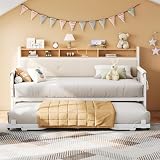
A full size daybed is a bed frame with a three-sided back and arms that holds a standard 54 x 75 inch full mattress, so it can pass as a sofa by day and a double bed by night. Expect the frame itself to measure roughly 56 to 57 inches wide and 77 to 79 inches long, which is a footprint of about 31 square feet. The catch is that true full-size daybeds are much scarcer than twin ones, so the choice comes down to a short list: a few metal frames (some with a pop-up trundle), an upholstered model, a storage version, and a heavy-duty option for adult guests. This guide compares them by measurements, weight limits and the room each one actually needs.
Most shoppers search for “full size daybed” because they want one piece that serves two jobs: a sitting spot in a den, home office or sunroom, and a proper guest bed that sleeps an adult without a fold-out. A full is 54 inches wide, which is 16 inches wider than a twin. That extra width is the difference between a bed an adult can sleep on comfortably and one that works for kids and short visits only. It is also the reason a full daybed takes real floor space, so the sections below start with room fit before moving to the products.
Full size daybed dimensions at a glance
| Measurement | Typical full daybed | Why it matters |
|---|---|---|
| Mattress size | 54 x 75 inches | Standard full mattress, not a double-length or full XL |
| Outer frame width | 56 to 57 inches | Only 1 to 3 inches of frame beyond the mattress |
| Outer frame length | 77 to 79 inches | Leaves little overhang past the mattress |
| Overall height | 31 to 45 inches | Upholstered models sit lower, metal scrollwork higher |
| Seat height with mattress | About 17 to 22 inches | Comfortable sofa height is near 18 inches |
| Weight limit (daybed) | 450 pounds is common, up to 1,000 on heavy-duty frames | Two adults plus mattress |
| Trundle (where included) | Twin, about 71 x 40.5 inches | The trundle is smaller than the bed above it |
| Floor space with 24 inches clearance on the open side | About 57 x 101 inches | Needed to walk and make the bed |
How much room does a full daybed need?
Measure the wall where the daybed will sit. Because the frame has a back and two arms, it sits flush against a wall and the open side faces the room. Allow at least 24 inches of clear floor in front for walking and tucking in sheets, and 30 to 36 inches if you want to stack cushions or fit a small bench. If the model has a trundle, add roughly 40 inches of pull-out clearance on the open side so the lower bed can roll all the way out.
- Minimum room: about 9 x 10 feet for a full daybed with no trundle and an occasional guest.
- Comfortable room: 10 x 12 feet or more, especially if the room doubles as an office.
- Doorway check: boxes for assembled-in-room frames are long and narrow, usually 6 to 7 feet by about 12 inches, so most standard 30 inch doors are fine. Fully assembled upholstered frames are the exception.
- Window and radiator clearance: the high back of metal daybeds can block a low window sill. Check that the frame back height, 31 to 45 inches, clears window handles.
Material and construction trade-offs
| Type | Strengths | Weak points | Best for |
|---|---|---|---|
| Metal tube frame | Light, strong, easy to move, often supports a trundle | Can squeak at joints, cold look, thin rails need slats or a link spring | Guest rooms, dorm-style spaces, budget buyers |
| Upholstered frame | Looks like a sofa, soft arms for sitting, quiet | Heavier, fabric can wear at the arms, harder to move up stairs | Living rooms, dens, adult guests |
| Solid wood frame | Very durable, repairable, warm look | Heavy, higher cost, bulky box | Long-term primary use |
| Storage base with drawers | Replaces a dresser, uses dead space under the bed | No trundle, drawers limit under-bed clearance, heavier to assemble | Small rooms and multi-use spaces |
Slat versus link spring support
A full daybed has to carry the mattress without a box spring, since there is no room for one inside the frame. Wood slats spaced about 2 to 3 inches apart give the best support for foam and hybrid mattresses. Metal link spring decks, common on older iron daybeds, flex more and can sag under a heavy foam mattress. For a full-size mattress used nightly, choose slats.
Mattress thickness limits
Daybed frames usually accept mattresses up to 8 or 9 inches. A thicker mattress rises above the arms and removes the sofa look, and if there is a trundle underneath it, the lower mattress often has a limit of only 5 to 6 inches. Check both numbers before buying a mattress.
The five full-size daybeds worth comparing
The list below sticks to full-size frames that are actually sold in that width, with dimensions from published specifications. Confirm current details on the maker’s page before you order; manufacturers revise frames and hardware from time to time. Cost is described by tier only.
1. DHP Bombay Metal Daybed with Trundle (full)
Specs: metal frame, full size daybed measuring about 77.5 inches long, 56 inches wide and 43 inches high. Includes a twin trundle of about 71 x 40.5 x 4 inches. Weight limit about 450 pounds for the daybed and 225 pounds for the trundle.
Best for: households that need a single piece that can sleep two people occasionally, such as when relatives visit with a child.
Pros:
- Trundle adds a second sleeping surface without extra floor space.
- Roundups regularly name it the best full-size daybed with a trundle.
- Classic scrolled-metal look suits traditional and farmhouse rooms.
Cons:
- The trundle is a twin and sits very low, so it suits kids and agile adults more than people with stiff knees.
- Trundle mattress must be thin.
Tier: mid-range.
2. DHP Lina Metal Daybed with Trundle
Specs: metal frame, about 56 x 77.5 x 43 inches, weight about 64 pounds, with a trundle bed.
Best for: shoppers who prefer a slightly lighter, simpler design with a trundle at a similar footprint to the Bombay.
Pros:
- Weighs about 64 pounds, light enough for two people to carry upstairs.
- Same compact footprint as other full metal daybeds.
- Trundle gives flexibility for guests.
Cons:
- Metal joints can loosen over time and need re-tightening.
- Not a plush option for adults who stay several nights.
Tier: budget to mid-range.
3. DHP Dale Upholstered Daybed (full)
Specs: upholstered frame, about 77.5 x 57 x 32 inches, weight about 113.5 pounds.
Best for: living rooms and dens where the daybed must look like a sofa first and a bed second.
Pros:
- At 32 inches high it sits lower and reads as a sofa in a living room.
- Upholstery softens the arms and back for sitting.
- Heavier build feels more stable than light metal frames.
Cons:
- At about 113 pounds, it is awkward on stairs for one person.
- Fabric needs occasional vacuuming and spot cleaning, especially with pets.
Tier: mid-range.
4. LIKIMIO Metal Daybed with Upholstered Headboard and Trundle
Specs: metal frame with upholstered headboard and trundle, about 77.2 x 53.9 x 44.8 inches, with a stated capacity of 1,000 pounds.
Best for: adult guests and heavier sleepers who want maximum weight rating.
Pros:
- High stated capacity gives confidence for two adults.
- Upholstered headboard is more comfortable to lean against than bare metal.
- Includes a trundle.
Cons:
- The listed width of about 53.9 inches is close to a full mattress, so check that the mattress seats cleanly.
- Less well known brand, so read the warranty terms.
Tier: mid-range.
5. DHP full-size daybed with built-in storage drawers
Specs: full-size frame listed at about 79 x 57 x 31.5 inches with two drawers built into the base and a stated capacity of about 450 pounds.
Best for: small rooms where the drawers replace a dresser and no trundle is needed.
Pros:
- Two drawers hold bedding, seasonal clothes or office supplies.
- Low 31.5 inch height keeps sight lines open.
- One-piece look without separate storage furniture.
Cons:
- No trundle option.
- Drawer slides are the first thing to wear on any storage bed, so avoid overloading.
Tier: mid-range.
A note on twin daybeds with trundles
Many popular daybed names are twin only. The Zinus Eden, for example, is about 77 x 39 x 38 inches and the Zinus Suzanne about 78 x 39 x 25.8 inches. If a listing shows a width near 39 inches, it is a twin and will not take a full mattress. Always compare the stated mattress size, not the product name.
Decision matrix: which full daybed fits your situation
| Your situation | Pick | Reason |
|---|---|---|
| Two guests sometimes, one adult plus a child | DHP Bombay with trundle | Full upstairs, twin pull-out |
| Lighter frame for upstairs move | DHP Lina | About 64 pounds |
| Living room that must look like a sofa | DHP Dale upholstered | 32 inch height and padded arms |
| Adult guests who are heavier | LIKIMIO with high capacity rating | 1,000 pound stated rating |
| Small office needing storage | Storage drawer model | Replaces a dresser |
| Kids and pets | Upholstered with removable cover, or metal | Easy to clean or wipe down |
| Renter who moves | Metal frame | Light and breaks down |
Setting up a full daybed so it works as a sofa
A daybed becomes a sofa with the right pillows. Use two or three firm bolster or square pillows against the back, and a long bolster along each arm if you want to recline. Choose a mattress cover or a quilted coverlet that tucks under the mattress, so the bed does not need to be remade each morning. A bed skirt hides the trundle track or under-bed storage. For a nicer look, drape a fitted throw over the mattress and add a pair of euro-sham pillows.
- Mattress choice: a 6 to 8 inch medium-firm foam or hybrid mattress keeps the seat height near 18 to 22 inches and the back above the cushions.
- Cushion depth: a full mattress is 75 inches long and 54 inches wide, so a sofa-style arrangement leaves the seat depth at the mattress width of 54 inches. That is deep, so back pillows are essential.
- Lighting: mount a sconce or place a floor lamp at the head; the frame back blocks side-table lamps if both are on the same wall.
Assembly, weight and durability realities
- Box size and weight: metal frames ship at 60 to 100 pounds with trundle, upholstered frames at 100 to 130 pounds. Plan on two people.
- Assembly time: one to two hours for most metal frames, two to three for upholstered or drawer models.
- Tighten hardware: re-check bolts after the first week and again after a month. Loose bolts are the main source of metal daybed squeaks.
- What wears first: trundle casters and tracks, then drawer slides, then upholstery on the arm edges.
- Weight limits: treat them as total static load. Two adults on a 450 pound rated frame with a heavy mattress is close to the limit.
- Floors: use felt pads under legs on hardwood to prevent scratches, and avoid rolling the trundle on thick rugs.
Choosing a mattress and bedding for a daybed
The mattress decides whether a daybed feels like furniture or like a cot. Because the arms and back sit only a few inches above the mattress, thickness matters more than on a normal bed. A 6 inch foam mattress leaves the back rail showing and keeps the seat near 17 to 19 inches high, which is the same as a typical sofa. An 8 inch hybrid pushes the seat toward 22 inches and covers part of the frame, which is more comfortable for sleeping but less sofa-like.
- Firmness: medium-firm works for both sitting and sleeping. Very soft foam makes the edge collapse when someone sits on it.
- Edge support: pick a mattress with a reinforced perimeter if it will be used as a sofa every day.
- Sheets: standard full fitted sheets fit, but deep-pocket sheets slip off thinner mattresses, so choose pockets that match the mattress thickness.
- Covers: a zip-around washable mattress cover protects against spills and keeps the daybed presentable between guest visits.
- Bolsters: two long bolsters of about 6 x 36 inches, or three standard 20 inch squares, give the back support that a daybed lacks.
If the frame includes a trundle, buy a second, thinner mattress sized for the lower deck. Trundle clearance is often only 5 to 6 inches, so a 4 to 5 inch foam mattress is the safe choice. A pop-up trundle that rises to the height of the upper bed needs a similar low-profile mattress, and both surfaces should be kept clean and dry, since the lower deck sits close to the floor and collects dust.
Full versus twin daybed: which size is right?
A twin daybed costs less and takes about 40 x 78 inches of floor, but it sleeps one comfortable adult. A full daybed adds 16 inches of width and about 15 square feet of footprint. Pick a full if adults will sleep on it for more than one or two nights, if two people may share it, or if the room has a large wall and the bed will be seen as a sofa. Pick a twin when the room is under 9 x 10 feet or guests are mostly children.
| Size | Mattress | Frame footprint | Comfortable for |
|---|---|---|---|
| Twin daybed | 38 x 75 inches | About 40 x 78 inches | One adult or child |
| Full daybed | 54 x 75 inches | About 56 x 78 inches | One adult comfortably, two for short stays |
Frequently asked questions
Do full size daybeds need a box spring?
No. Daybed frames are designed to take a mattress directly on slats or a link spring deck, and a box spring would not fit between the arms.
What mattress fits a full size daybed?
A standard 54 x 75 inch full mattress, usually 6 to 8 inches thick. A mattress above 9 inches may rise above the frame and block the sofa look.
Can two adults sleep on a full daybed?
For short stays, yes, but a full is only 54 inches wide, so each person gets 27 inches. Treat it as a guest bed rather than a main bed for a couple.
Are full size daybeds with trundles available?
Yes. Models such as the DHP Bombay and Lina pair a full upper bed with a twin trundle. Note that the trundle is a different size from the bed above it.
How much weight does a daybed hold?
Many hold about 450 pounds on the main bed and 225 pounds on the trundle, with heavy-duty frames rated up to 1,000 pounds. Check the manufacturer’s rating.
Where should a daybed go in a room?
Against the longest wall, away from heating vents, with 24 inches of walkway on the open side. Avoid placing it where a door swing hits the arm.
Is an upholstered or metal daybed better?
Upholstered models look more like furniture and are quieter; metal frames are lighter, cheaper and more common with trundles. Choose by room style and how often you move.
Final checklist
- Confirm the listing is a full, 54 x 75 mattress, not a twin.
- Measure the wall, the open-side clearance and the door path.
- Choose slats over a link spring for foam mattresses.
- Check the mattress thickness limit for both the top bed and the trundle.
- Match the weight rating to your guests.
- Plan two people for assembly and re-tighten hardware after a month.
A full size daybed rewards a little planning. Measure the room, pick the frame type that fits how the space is used, and keep the mattress thin enough to preserve the sofa look. Done well, one footprint serves as a reading nook by day and a real guest bed at night.