Key takeaways
- Footprint and clearance — the bike’s own dimensions are only half the story. You need space in front for your arms and a screen, and space at the sides to dismount without clipping a wall.
- Resistance system — friction pads, manual magnetic, and electromagnetic resistance have very different maintenance lives and price floors.
- Adjustability — seat height, seat fore/aft, handlebar height, and handlebar reach. If one of those four is missing, a household with two riders of different heights will fight over the bike.
- Storage and moving — transport wheels, box weight, and whether the bike rolls through your doorways.
The short answer: the best spin bike deals cluster in three bands — roughly $300–$600 for compact magnetic belt-drive bikes that fit an 8 × 10 ft corner, $700–$1,200 for mid-range magnetic bikes with Bluetooth and app support, and $1,400–$2,600 for connected bikes with built-in touchscreens. Buy the smallest footprint that still feels stable under you, because footprint and adjustability decide whether you actually ride the thing, and the resistance system decides what you’ll be replacing in two years.
The four criteria that actually decide a spin bike purchase
Every deal you’ll see advertised is really a trade-off between four things: how much floor the bike eats, how the resistance is generated, how many ways the bike adjusts to your body, and how hard it is to store or move when you’re not riding it. Price tracks those four, but not evenly. A $500 bike and a $1,200 bike often share the same frame geometry and the same 40 lb flywheel; the extra money usually goes to the resistance mechanism, the console, and the adjustability range.

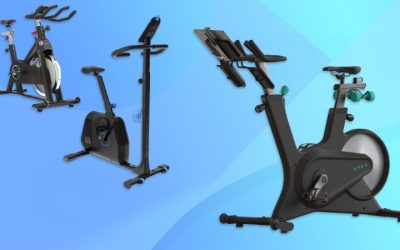
MERACH Exercise Bike, Friction Stationary Bike for Home with App Training
Included for 'Best Spin Bike Deals for Home Workouts' because the listing specifies Friction Stationary Bike for Home with App Training, details this guide uses to compare options.
View on Amazon
OLIXIS Exercise Bike with APP Control, Brake Pad Stationary Bikes with Quiet Magnetic Resistance, Indoor Cycling Spin Workout Bike with 300.0 lbs Weight Capacity, Classic Orange
Included for 'Best Spin Bike Deals for Home Workouts' because the listing specifies Brake Pad Stationary Bikes with Quiet Magnetic Resistance and Classic Orange, details this guide uses to compare options.
View on Amazon
Superun Exercise Bike, Stationary Bike with 33-Level Magnetic Resistance
Included for 'Best Spin Bike Deals for Home Workouts' because the listing specifies Stationary Bike with 33-Level Magnetic Resistance, details this guide uses to compare options.
View on Amazon
Merach Magnetic Exercise Bike with 21.5” HD Display & Auto Resistance
Included for 'Best Spin Bike Deals for Home Workouts' as a relevant option in this category; details come from the product listing.
View on AmazonHere’s the order that matters most for home use:
- Footprint and clearance — the bike’s own dimensions are only half the story. You need space in front for your arms and a screen, and space at the sides to dismount without clipping a wall.
- Resistance system — friction pads, manual magnetic, and electromagnetic resistance have very different maintenance lives and price floors.
- Adjustability — seat height, seat fore/aft, handlebar height, and handlebar reach. If one of those four is missing, a household with two riders of different heights will fight over the bike.
- Storage and moving — transport wheels, box weight, and whether the bike rolls through your doorways.
Footprint and clearance: the numbers that decide your room
Measure the wall you plan to use before you look at any price. A spin bike needs roughly 24–36 inches of clear space in front of the handlebars so you can stand out of the saddle without your head near a wall or a low ceiling fan, and 12–18 inches on each side to step on and off. Behind the bike, 4–6 inches is usually enough unless the model has an incline/decline mechanism that tilts the frame.
| Bike class | Typical footprint (L × W) | Bike weight | Clearance in front | Realistic minimum room |
|---|---|---|---|---|
| Compact budget magnetic | 44–50 in × 20–23 in | 60–85 lb | 24 in | 8 × 10 ft |
| Mid-range magnetic, tablet holder | 48–52 in × 21–24 in | 90–115 lb | 30 in | 9 × 10 ft |
| Connected bike, 22 in screen | 55–60 in × 22–25 in | 130–160 lb | 36 in | 10 × 11 ft |
| Incline/decline connected bike | 55–60 in × 23–26 in | 180–210 lb | 36 in | 10 × 12 ft |
| Commercial studio bike | 48–52 in × 24–26 in | 85–130 lb | 30 in | 9 × 11 ft |
| Leaning smart bike | 58–62 in × 24–26 in | 150–170 lb | 36 in | 11 × 12 ft |
Two measurements catch people out. First, ceiling height: a 6 ft rider standing in the pedals needs about 7 ft 6 in of clearance to the ceiling, so a basement with 7 ft joists is tight and a sloped attic corner is usually a no-go. Second, doorways. A standard interior door is 30–32 in wide, and a spin bike box is typically 42–52 in long, 30–36 in tall, and 10–12 in deep, weighing anywhere from 60 to 220 lb. That box will not fit through a 28 in hallway turn, and it will not go up a narrow stairwell without being unpacked first.
Resistance systems: what you’re paying for and what wears out
This is where most of the price difference lives, and it’s the part of the bike most likely to need attention.
| System | Feel | Maintenance | Noise | Typical price band | First thing to fail |
|---|---|---|---|---|---|
| Felt pad on flywheel | Progressive, slightly gritty at high tension | Pad replacement every 6–18 months, $15–$30 part | Moderate; can squeal | $200–$600 | Felt pad, then glazed flywheel surface |
| Manual magnetic, 32–100 levels | Consistent, smooth, no contact | Essentially none; wipe the flywheel | Very quiet | $400–$1,200 | Tension cable, then bottom-bracket bearings |
| Electromagnetic, auto-resistance | Most consistent, changes with the app | None mechanical; electronics can fail | Silent | $1,200–$2,600 | Control board or power supply |
| Motor-driven smart bike | Electronic shifting, virtual gearing | Firmware updates; proprietary parts | Silent | $2,600–$4,200 | Electronics or drivetrain sensors |
The practical takeaway: a friction-pad bike is the cheapest way to get a heavy flywheel and a stable ride, but you’re signing up for a consumable part. A magnetic bike costs $100–$300 more for the same frame and gives you years of zero-maintenance resistance. Electromagnetic resistance is worth the premium only if you want the bike to change resistance on its own during a class — otherwise you’re paying for a control board you don’t need.
Adjustability: four contact points, and the ranges that matter
A spin bike fits you through four adjustments. Missing any one of them is the single most common reason a bike ends up folded in a spare room.
- Seat height — should span at least 10 inches of travel. Set it so your knee is slightly bent at the bottom of the pedal stroke; for most riders that puts the saddle roughly level with the top of your hip bone when you stand next to the bike.
- Seat fore/aft — lets you set knee-over-pedal. Budget bikes often skip this. If two riders share the bike, mark your settings with tape or a paint pen, because most budget bikes have no numbered scale.
- Handlebar height — needs to come up to at least saddle height for riders with back or hip issues; a bike that only drops low forces a long, aggressive reach.
- Handlebar reach — the rarest adjustment. Without it, a 5 ft 2 in rider and a 6 ft 2 in rider cannot both be comfortable on the same frame.
Pedals matter too. Most home bikes ship with dual-sided pedals — a cage on one side and an SPD clip on the other. If you already own cycling shoes with a different cleat system, budget $40–$90 for replacement pedals rather than changing your shoes.
Matching the bike to your situation
| Your situation | What to prioritise | What to avoid | Where to shop in the range |
|---|---|---|---|
| Studio apartment under 400 sq ft | Under 50 in long, under 100 lb, front transport wheels | Incline/decline frames, 60 in connected bikes | $300–$600 magnetic |
| Renter who moves every 1–2 years | Box under 80 lb, mostly pre-assembled, quick-release seat post | 200 lb frames, proprietary consoles | $250–$550 magnetic |
| Kids and pets in the house | Fully enclosed flywheel, wide stabilisers, no exposed friction pad or cords | Exposed flywheel edges, pedal straps that dangle | $600–$1,000 magnetic |
| Two riders, 5 ft 2 in and 6 ft 2 in | Seat fore/aft, handlebar reach, numbered scales | Two-way adjustment only | $800–$1,500 |
| Back or hip issues | Handlebar height that reaches saddle height, upright geometry | Aggressive race geometry, low bars | $600–$1,200 |
| Structured training, power zones | Electromagnetic resistance, power accuracy within 2–5% | Friction pads, estimated-only power | $1,200–$2,600 |
| Basement gym, multiple daily users | Sealed bearings, serviceable parts, 100 lb+ frame | Budget consoles, plastic seat posts | $2,000–$3,500 commercial |
Storage, assembly, and what actually wears out
Spin bikes are heavy and awkward, and that shapes daily life with one more than the spec sheet suggests. A 100 lb bike with front transport wheels rolls easily on hardwood or tile and grudgingly on thick carpet. A 200 lb connected bike with an incline motor effectively lives where you assemble it.
Assembly is usually 30–60 minutes with the included tools: stabilisers, seat post, handlebar post, pedals, console, and on connected bikes, the screen and its cable. Two people make the flywheel-end assembly much easier. Keep the box until you’ve ridden the bike once — a missing bolt is far easier to resolve with the original packaging.
Floor protection is worth the $30–$60 for a rubber equipment mat roughly 4 × 2 ft and 6–8 mm thick. Sweat is the real enemy: it drips onto the frame, the seat post collar, and the flywheel housing, and salt corrosion is what kills bikes that otherwise have plenty of life left. Wipe the frame down after every ride and dry the seat post clamp.
What wears first, in order: the friction pad on budget bikes, then the seat (stock saddles are the first thing most riders replace, $40–$90), then the pedals and their bearings, then the bottom bracket. Magnetic resistance units themselves rarely fail. Electronics fail before mechanicals do on connected bikes, and out-of-warranty control boards are the expensive repair.
Connected bikes with built-in screens
Peloton Bike
The reference point for connected home cycling. Magnetic resistance with a manual knob, a touchscreen in the 22-inch class, and a frame that measures about 4 ft long by 2 ft wide at roughly 135 lb. Seat adjusts up/down and fore/aft; handlebars adjust up/down only. Front-mounted wheels let you tilt and roll it into a corner. Typical pricing sits around $1,400–$1,600, occasionally dipping to $1,200 in promotional windows. The catch is the subscription: classes, scenic rides, and the leaderboard require an ongoing membership, and the bike is a fairly plain manual-resistance machine without it. Best for a household that will genuinely use instructor-led classes three or more times a week, in a room at least 10 × 11 ft. Buy used only if the screen works and the resistance knob turns smoothly through its full range.
Peloton Bike+
The same frame geometry as the standard Bike with two meaningful upgrades: a larger rotating screen in the 24-inch class, and auto-resistance, which means the bike changes tension itself during a class instead of you turning a knob. Weight is roughly 140 lb and the footprint is identical, so it does not cost you extra floor space. Typical pricing runs $2,400–$2,600. Auto-resistance is the feature that justifies the step up if you follow structured power-zone classes; if you mostly ride your own intervals, the standard Bike is the better deal. The rotating screen matters more than it sounds — it lets you take strength and yoga classes off the bike in the same room without a second screen. Both models need a dedicated outlet within about 6 ft, since the screen is mains-powered.
NordicTrack Commercial S22i Studio Cycle
The one feature nothing else in this price range matches: a frame that physically inclines up to roughly 20% and declines to about -10%, so a class that simulates a climb actually tilts you. Resistance is digital magnetic with roughly two dozen levels, controlled automatically by the training app or manually by you. The rotating touchscreen is in the 22-inch class, and the bike measures about 4.5 ft long by 2 ft wide at roughly 200 lb — heavy enough that it stays where you put it. Typical pricing is $1,500–$2,000, with sale windows landing around $1,000–$1,300. The incline mechanism adds moving parts and a second motor, so it needs more rear clearance than a flat-frame bike, and it needs a taller ceiling for standing climbs. Best for riders who want terrain simulation without a smart trainer setup.
NordicTrack Commercial S15i Studio Cycle
The S15i is the same incline/decline platform as the S22i with a smaller screen in the 15–16-inch class, which drops the price to roughly $1,000–$1,500, with promotions near $700–$1,000. Footprint and weight are close to the S22i, so the storage calculus is unchanged. If you’re going to run the classes through a tablet or a TV anyway, the smaller built-in screen costs you little. If you plan to read the screen from the saddle without glasses, the bigger panel is worth the difference. The 15-inch panel also makes the bike feel slightly less top-heavy when you tilt it on its front wheels, which matters if you’re rolling it in and out of a closet.
Echelon EX-3
A bring-your-own-device connected bike: no built-in screen, just a tablet holder and Bluetooth, so you use your own tablet or phone with the brand’s app or a third-party one. Resistance is manual magnetic with 32 levels, belt drive, and a frame that runs roughly 4.5–5 ft long at about 100 lb. Typical pricing is $600–$1,000, with frequent promotions in the $400–$700 range, and the app membership is optional rather than required. That makes the EX-3 one of the better deals for someone who wants a solid magnetic bike and already owns a tablet. The trade-off is that the tablet holder flexes under a heavy tablet, and there’s no auto-resistance, so every tension change is your hand on the knob. Seat adjusts four ways; handlebars two ways.
Echelon EX-5s
Steps up to a rotating built-in touchscreen in the 22-inch class, auto-resistance that follows the class, and dual-sided pedals. The frame and flywheel are shared with the EX-3, so the footprint is essentially the same at roughly 4.5–5 ft long and just over 100 lb. Typical pricing is $1,000–$1,400, dropping to $700–$1,000 on promotion. Compared with the Peloton Bike+, the EX-5s is meaningfully cheaper but the app ecosystem is smaller and the screen software less polished. It’s a reasonable middle path for a household that wants auto-resistance without the premium brand premium. Assembly is similar to the EX-3; the screen cable is the fiddly part.
Echelon EX-7s
The top of the Echelon line: the largest screen of the three, auto-resistance, a better saddle, and upgraded pedals, on the same basic frame architecture. Expect roughly $1,400–$2,000, or $1,000–$1,400 in promotional windows. Weight is still in the 100–120 lb class, so it stores more easily than the 200 lb incline bikes. At this price you’re choosing between the EX-7s and the NordicTrack S22i, and the decision is simple: pick the Echelon if you want a lighter, flatter bike that’s easier to move; pick the NordicTrack if terrain simulation is the thing that keeps you riding. Neither needs a permanently dedicated room, but both want 10 ft of width once you count dismount space.
Bowflex VeloCore
The odd one out: a frame that leans side to side when you unlock it, which recruits your core and makes steady-state riding noticeably more demanding. It’s a full-length bike, roughly 60 in long by 25 in wide at around 160 lb, and leaning mode needs 18 in of clear space on each side — that’s the number that disqualifies most apartments. Magnetic resistance with around 100 levels, belt drive, and a screen in either the 16-inch or 22-inch class depending on trim. Typical pricing is $1,500–$2,000, with sales around $1,000–$1,500. The lockout makes it a conventional bike when you want one. Best for riders with 11 ft of room width and a genuine interest in the leaning mode, because you’re paying for a mechanism you won’t use otherwise.
ProForm Studio Bike Pro
A connected bike with a rotating touchscreen in the 22-inch class, digital magnetic resistance of roughly two dozen levels, and a frame in the 55–58 in long range at about 130–150 lb. Typical pricing is $800–$1,200, dropping to $600–$900 on promotion, which makes it one of the cheaper ways into a built-in screen. It’s manual-resistance, not auto-resistance, so the classes tell you what to do rather than doing it for you. The subscription is effectively required to get much out of the screen. Seat adjusts four ways. If you want the screen experience at the lowest entry price and can live without the bike changing tension on its own, this is the value pick in the connected category.
Mid-range magnetic bikes with no screen
Schwinn IC4
The default recommendation for most home riders, and the bike most other mid-range options get compared against. Belt drive, a 40 lb flywheel, and 100 micro-adjustable magnetic resistance levels with no friction pad to replace. Footprint is about 49 in long by 21 in wide at roughly 106 lb, with a 330 lb user weight limit. The LCD console is basic, but Bluetooth FTMS means it broadcasts speed, cadence, and heart rate to third-party apps, so you can run whatever training platform you prefer on your own tablet. Typical pricing is $800–$1,000, with regular promotions at $500–$700. Seat adjusts four ways, handlebars two ways. Quiet enough for an apartment with neighbours below, and it rolls on front wheels. This is the sweet spot for renters and small spaces.
Bowflex C6
Mechanically the same bike as the IC4 — same frame, same 40 lb flywheel, same 100 magnetic levels, same Bluetooth — with a different saddle, different pedals, and the brand’s own app as the software pitch. Footprint and weight are effectively identical at roughly 49 in by 21 in and about 106 lb. Typical pricing is $800–$1,000, with sales at $500–$700, so the two are usually within $50 of each other. Buy whichever is cheaper on the day. The decision between them is about pedals and saddle preference, not engineering: the Bowflex ships with a slightly different pedal set, and neither stock saddle wins prizes. Budget $40–$90 for a replacement saddle with a cutout if you ride more than twice a week.
Schwinn IC Pro
Sits above the IC4 in the same family: magnetic resistance, belt drive, a 40 lb flywheel, Bluetooth, and a slightly beefier frame in the 110–120 lb range at about 50 in long. Typical pricing is $700–$1,100. What you get over the IC4 is largely build refinement — a more solid feel at high cadence out of the saddle, better pedals, and a sturdier console mount — rather than a different resistance system. If you’re a heavier rider or you ride hard and often, the extra rigidity is worth the money. If you ride 20–30 minutes a few times a week, the IC4 is the better deal and the IC Pro is money spent on margin. Same four-way seat, same two-way handlebars.
Horizon 7.0IC
A magnetic belt-drive bike aimed at riders who want a gym feel without a screen: roughly 100 resistance levels, a 40 lb flywheel, Bluetooth connectivity for heart rate and third-party apps, and a frame around 50–55 in long at about 100–110 lb. Typical pricing is $800–$1,100. The sibling 5.0IC strips the resistance range and the console down and usually runs $500–$700, which makes it a reasonable apartment alternative. Both use the same adjustment layout — four-way seat, two-way handlebars — and both roll on front transport wheels. The 7.0IC’s advantage is a heavier, more stable base at sprint cadence; the 5.0IC’s advantage is that it’s lighter and easier to move alone.
Diamondback 510IC
A magnetic belt-drive bike with a modest number of resistance levels, a flywheel in the 30–40 lb class, and a console that includes heart-rate contact grips. Footprint is roughly 48–52 in long at around 100–110 lb. Typical pricing runs $500–$800, and it’s often discounted more aggressively than the Schwinn or Horizon equivalents, which is the main reason to consider it. Adjustability is four-way seat and two-way handlebars. The resistance range is narrower than the 100-level bikes, so the jumps between settings are more noticeable if you’re chasing precise power targets. For steady-state riding, intervals by feel, or a second bike for a household, it’s a competent and inexpensive option that doesn’t need a subscription.
Sole SB700
A magnetic belt-drive bike built on a heavier frame than the budget tier, roughly 50–55 in long and in the 120–130 lb range, with a flywheel around 40 lb and a console that includes heart rate. Typical pricing is $800–$1,200. The appeal is durability and a planted feel rather than connectivity — Bluetooth is limited compared with the Schwinn and Horizon bikes, so plan on using it without app integration or with a separate cadence sensor. It suits a heavier rider or a household where the bike gets used daily and needs to feel like gym equipment. Assembly is straightforward, but at this weight you want two people for the stabiliser step.
Sunny Health & Fitness SF-B1805
One of the better-value magnetic bikes: a 44 lb flywheel, belt drive, and magnetic resistance with a tension knob, plus a small LCD and a tablet holder. Footprint is compact — roughly 45–48 in long by 20–22 in wide — at about 90–100 lb, which puts it comfortably in an 8 × 10 ft room. Typical pricing is $300–$500. The resistance range is narrower than the 100-level bikes and the console is basic, but there’s no friction pad to replace and the belt drive is quiet enough for apartment use. Adjustability is four-way seat and two-way handlebars. This is the pick if you want magnetic resistance on a small budget and don’t care about app connectivity.
Sunny Health & Fitness Synergy Pro
A step up within the same brand: magnetic resistance, a 40 lb flywheel, belt drive, and a better performance monitor with cadence, plus a sturdier frame in the 100–110 lb range at roughly 48 in long. Typical pricing is $400–$700. It’s aimed at riders who want more stability at speed than the cheapest Sunny models provide without jumping to the $800+ tier. The trade-off is that the console is still not app-connected in the way the Schwinn and Horizon bikes are, so if you want Zwift or a class app to read your cadence, budget $30–$60 for a separate Bluetooth speed/cadence sensor. Seat adjusts four ways.
Joroto X4S
A budget magnetic belt-drive bike with a flywheel in the 35 lb class, a tablet holder, and an LCD console. Footprint is compact at roughly 44–47 in long, and weight lands around 85–95 lb, making it one of the easier bikes to move alone. Typical pricing is $300–$500. It’s a reasonable first spin bike for someone who isn’t sure they’ll stick with it, and the magnetic resistance means no pad replacement. What you give up versus the $700+ tier is frame rigidity at high cadence, a narrower resistance range, and a less refined seat and pedals. If you ride out of the saddle a lot and you’re over about 200 lb, the flex becomes noticeable; the heavier mid-range bikes are worth the extra money.
Budget bikes under $600
Schwinn IC3
The classic entry-level spin bike: a 40 lb flywheel, belt drive, and friction-pad resistance rather than magnetic. Footprint is about 48 in long by 21 in wide at roughly 100 lb. Typical pricing is $400–$600, with sales at $300–$450. The ride feel is genuinely good for the money — the heavy flywheel gives smooth momentum — but you’re buying a consumable: the felt pad wears and needs replacing every 6–18 months at $15–$30 a part, and the tension feel degrades as the pad glazes. The console is basic with no Bluetooth. Buy it if the price gap to the IC4 matters more than long-term maintenance, and budget for a pad and a better saddle in year one