Key takeaways
- Cool or low heat: useful for finishing a style and reducing scalp discomfort.
- Medium heat: the practical everyday setting for roller sets and treatments.
- High heat: useful for thick, damp hair, but best used with breaks and careful temperature checks.
- Low speed: gentler around lightweight rollers, edges, and delicate styles.
- High speed: helpful when the hair is very wet, provided the hood distributes air evenly.
The best hooded dryers for home hair styling are the ones that match your hairstyle, available floor or table space, and tolerance for heat, noise, and setup time—not simply the model with the highest wattage.
Quick picks by home situation
| Situation | Best dryer type | What to prioritize | Likely trade-off |
|---|---|---|---|
| Small apartment or shared room | Compact tabletop bonnet dryer | Foldable hood, under 12 lb, low and medium heat, timer | Less headroom and usually slower drying |
| Frequent roller sets or thick hair | Full-size hard-hat or standing hood dryer | Large hood opening, 1,000–1,500 watts, adjustable height | More floor space, heat, and storage effort |
| Children, pets, or light sleepers | Lower-speed bonnet dryer | Stable base, insulated hood, quiet motor, automatic shutoff | Longer sessions than a high-speed salon unit |
| Back or neck discomfort | Height-adjustable seated dryer | Wide chair clearance, tilting hood, controls within reach | Typically heavier and harder to move |
| Renter with limited storage | Collapsible tabletop bonnet | Removable hose or hood, compact folded dimensions, carry handle | Less even airflow around very large rollers |
What separates the best hooded dryers?
A hooded dryer surrounds the head with warm air rather than directing a concentrated stream at one area. That makes it useful for roller sets, deep-conditioning treatments, braid-outs, twists, and gently drying textured hair. The important differences are hood geometry, airflow control, temperature range, seating position, and how easily the unit can be put away.

Red by Kiss 3000 Ceramic Tourmaline Professional Hood Dryer, 4 Heat Settings Blow Dryer for Home & Salon, Height Adjustable Convenient Big Hood Size Extra Coverage (1875 Wattage)
Included for 'Best Hooded Dryers for Home Hair Styling' because the listing specifies 4 Heat Settings Blow Dryer for Home & Salon, details this guide uses to compare options.
View on Amazon
TASALON Ionic Hooded Hair Dryer - 1875W Bonnet Dryer with 3 Temperature Settings - Portable Standing Dryer for Home and Salon
Included for 'Best Hooded Dryers for Home Hair Styling' because the listing specifies 1875W Bonnet Dryer with 3 Temperature Settings and Portable Standing Dryer for Home and Salon, details this guide uses to compare options.
View on Amazon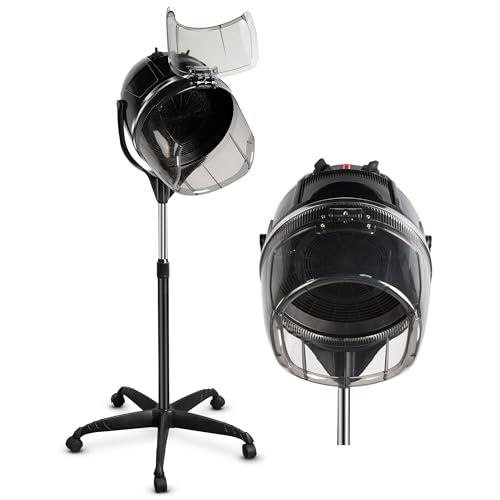
TASALON Professional Hooded Bonnet Hair Dryer Stand, Rolling Wheels & Timer
Included for 'Best Hooded Dryers for Home Hair Styling' because the listing specifies Rolling Wheels & Timer, details this guide uses to compare options.
View on Amazon
VEVOR 1875W Hooded Bonnet Dryer with Variable Speed, Temperature, Timer, and Wheels for Beauty Salon and Home Spa
Included for 'Best Hooded Dryers for Home Hair Styling' because the listing specifies Temperature and Timer, details this guide uses to compare options.
View on AmazonHood size and clearance
A small hood can work well for short hair, flexi-rods, or a simple conditioning cap, but it may press against large rollers or leave the nape outside the warm-air zone. For shoulder-length or longer hair, look for an opening roughly 10–13 inches wide and at least 8–10 inches of usable depth. A deeper hood is especially helpful when rollers extend behind the head.
Measure your hairstyle, not just your head. Large magnetic rollers can add 3–5 inches to the head’s width, while a tall roller set may need 12–16 inches of vertical clearance. The hood should sit around the hair without crushing the top rollers or touching the ears and neck.
For a floor-standing unit, leave about 24 inches of clear space behind the chair and 30 inches in front so you can sit down, stand up, and move the dryer safely. In a 10 × 12-foot room, a standing hood can fit comfortably if it occupies one corner, but it becomes awkward when placed between a bed and a dresser. A tabletop model usually needs a desk or table at least 18 inches deep and 24 inches wide.
Heat and speed settings
More heat is not automatically better. High heat can shorten a drying session, but it can also make the scalp uncomfortable and over-dry porous or chemically treated hair. The most useful home configuration is usually three temperature levels—cool, warm, and hot—combined with at least two airflow speeds.
- Cool or low heat: useful for finishing a style and reducing scalp discomfort.
- Medium heat: the practical everyday setting for roller sets and treatments.
- High heat: useful for thick, damp hair, but best used with breaks and careful temperature checks.
- Low speed: gentler around lightweight rollers, edges, and delicate styles.
- High speed: helpful when the hair is very wet, provided the hood distributes air evenly.
Wattage gives only a rough indication of drying power. A well-shaped hood with balanced vents may dry more evenly than a higher-wattage unit with a narrow airflow path. For home use, roughly 800–1,200 watts is common for compact models, while larger standing dryers may reach about 1,200–1,500 watts. Check that the outlet can support the appliance and avoid using an extension cord unless the manufacturer specifically permits it.
Tabletop bonnet or seated hard-hat design?
Tabletop dryers
A tabletop bonnet dryer is the better choice when storage matters more than maximum speed. Many have a flexible hood connected to a base or hose, and some fold down for a closet or under-bed storage. They are convenient for renters because they do not require permanent installation and can be used at a dining table, vanity, or desk.
Check the table height before buying. A surface around 28–30 inches high generally positions a seated adult’s head comfortably, but a low coffee table can force the neck downward. The base should not hang over the edge; allow at least 2 inches of support on every side. If the dryer weighs 8–12 pounds, confirm that a folding table or lightweight desk can hold it without wobbling.
Seated hard-hat dryers
A hard-hat dryer places a rigid hood over the head and often includes a height-adjustable stand, casters, or a built-in seat. It is usually the better option for frequent roller sets, long hair, and people who want even coverage without holding a bonnet in place.
Look for a hood that tilts or slides rather than forcing you to bend your neck. A seat height of about 17–20 inches works for many adults, but people with knee or hip limitations may prefer a taller chair. Confirm the maximum hood height and the distance between the chair back and hood; a bulky headrest or high-backed chair may prevent correct positioning.
Standing dryers are also the least convenient to move. A boxed unit may weigh 20–40 pounds, and the assembled base can be wider than 24 inches. Measure doorways, elevator openings, and tight hallway turns before ordering. Removable casters help, but they do not make a large base easy to carry upstairs.
Noise, timers, and everyday controls
Noise is often overlooked because a hooded dryer is used for 20–60 minutes at a time. A motor described as quiet may still be audible across a small apartment. If you watch television, work, or share a room, favor a lower-speed setting and a motor housing with insulation. Avoid models that rattle when the hood is extended; vibration often becomes more noticeable on a hollow table or hard floor.
A timer is one of the most useful safety features. A practical range is 15–60 minutes, with an automatic shutoff at the end. Short increments, such as five or ten minutes, make it easier to finish a treatment without repeatedly getting up. A timer does not replace checking the scalp: stop the cycle if the heat feels painful, the skin becomes unusually red, or the hair feels brittle.
Controls should be reachable while seated. Dials are often easier to operate with wet hands than small touch buttons. A separate heat and speed control is more useful than a single “low/high” switch because it lets you combine warm air with gentle airflow.
Storage, cleaning, and durability realities
Measure the stored footprint, not only the operating footprint. A collapsible bonnet may fit in a 12 × 12 × 8-inch cabinet when folded, while a standing hood can need a 24 × 24-inch corner even when not in use. Leave ventilation space around the motor and never store the dryer while it is still warm.
Lint, styling products, and hair can clog the intake grille. A removable or easily accessible filter is a major advantage. Clean the grille according to the instructions, and keep the hood fabric or plastic interior dry before folding it. The parts most likely to wear first are the hood hinge, flexible hose, caster locks, power switch, and plastic adjustment knobs. A metal stand may last longer than a lightweight plastic one, but it will add weight and may scratch flooring.
| Feature | Compact home target | Full-size target | Why it matters |
|---|---|---|---|
| Operating footprint | About 18 × 18 inches | About 24 × 24 inches | Determines whether it fits beside furniture |
| Weight | 6–14 lb | 20–40 lb | Shows how realistic frequent moving will be |
| Heat settings | At least 3 | At least 3, preferably with cool | Allows better control for different hair conditions |
| Timer | 15–60 minutes | 15–60 minutes | Reduces the need to monitor every minute |
| Clearance around the unit | 6 inches from walls | 12 inches from walls and furniture | Helps airflow and prevents accidental contact |
How to choose in five steps
- Measure your largest hairstyle. Include the width and height of rollers, rods, braids, or a conditioning cap.
- Choose the location. Decide whether you will use the dryer at a table, in a chair, or in a dedicated corner.
- Set a minimum control standard. Require three heat settings, two speeds, and an automatic timer for regular use.
- Check movement and storage. Confirm the folded size, assembled weight, doorway clearance, and available outlet.
- Match the airflow to your hair. Choose gentler, adjustable airflow for fragile or fine hair and a larger hood with stronger circulation for dense or long hair.
For occasional treatments and small homes, a foldable tabletop bonnet is usually the best balance of price, storage, and convenience; these commonly cost about $40–$120. For frequent sets and longer hair, expect roughly $100–$300 for a more capable bonnet or compact hard-hat design. Heavy salon-style standing units commonly range from $300–$800 or more. The right choice is the model you can position comfortably, clean easily, and store without turning every styling session into a furniture rearrangement.