Key takeaways
- Runtime: Aim for at least 6–8 hours from a fresh battery or a full charge.
- Control: A remote or intermittent setting is useful when ducks approach and the spread needs to become less conspicuous.
- Transport: Check whether the pole, wings, battery, and body fit inside the same bag.
- Weather resistance: Sealed switches and protected battery compartments matter more than cosmetic features.
- Noise: A quiet motor is preferable in calm conditions and close-range hunting.
The best duck decoys for realistic field setups are durable, species-appropriate floaters or field decoys matched to your hunting location, with enough contrast and motion to remain visible without making the spread look artificial.
Quick picks by hunting situation
| Hunting situation | Best decoy choice | Recommended setup | Why it works |
|---|---|---|---|
| Small farm pond or narrow marsh | Standard-size mallard or mixed puddle-duck decoys | 6–12 decoys, including 1–2 active-motion units | Fits limited water while giving passing ducks a clear landing pocket |
| Large lake or windy reservoir | Oversized mallards, pintails, or high-visibility puddle ducks | 12–24 decoys with weighted lines and a few motion decoys | Larger bodies remain visible through chop and at longer distances |
| Flooded timber or shallow flooded crops | Standard field or water decoys in natural, low-gloss paint | 6–18 decoys in irregular family groups | Moderate size and subdued finish look more natural in close quarters |
| Open-field goose-and-duck setup | Field mallard, pintail, or mixed puddle-duck decoys | 12–36 decoys, depending on field size and target species | Field bases prevent tipping and silhouettes remain visible from above |
| Walk-in public land | Lightweight hollow-body decoys or compact foam-filled decoys | 6–12 decoys in a backpack or decoy bag | Reduces the cost of carrying the spread through long, uneven walks |
| Diver-duck water | Bluebill, canvasback, redhead, or ring-neck decoys | 12–24 diver decoys on long lines | Diver shapes and low riding profiles are more convincing on open water |
Choose the right duck species first
Mallard and other puddle ducks
Mallards are the most versatile starting point because they work in marshes, ponds, flooded timber, and many agricultural fields. A mixed spread can include mallards with gadwalls, wigeon, teal, or pintails to avoid presenting a monotonous group. Mallard decoys are usually available in standard and oversized versions, making them useful for both close-range cover and large open water.

Final Approach Last Pass Mallard Floaters, Decoy 12 Pack
Included for 'Best Duck Decoys for Realistic Field Setups' because the listing specifies Decoy 12 Pack, details this guide uses to compare options.
View on Amazon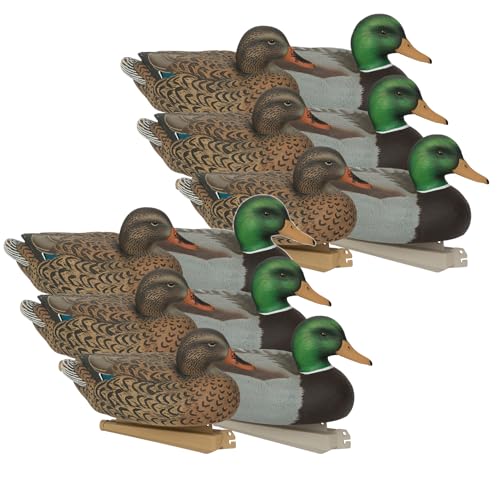
Avery GHG Essential Mallard Duck Decpus - 12 Pack
Included for 'Best Duck Decoys for Realistic Field Setups' because the listing specifies 12 Pack, details this guide uses to compare options.
View on Amazon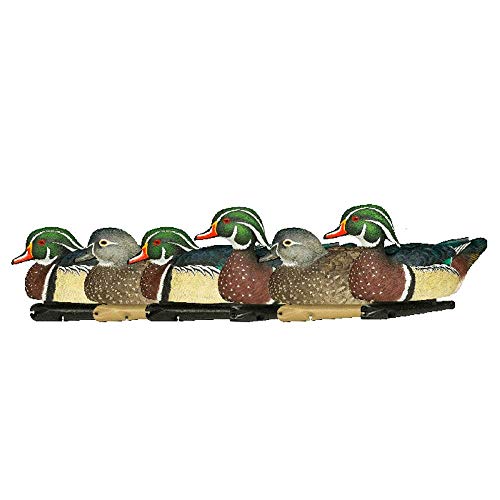
Avian X Top Flight Wood Duck & Mallard Hunting Floater Decoys, Green (6 Pack)
Included for 'Best Duck Decoys for Realistic Field Setups' because the listing specifies Green (6 Pack), details this guide uses to compare options.
View on Amazon
ZINK Floater Wood Duck Decoys | 6-Pack Life-Size Floating Decoys for Duck Hunting | 3 Drakes & 3 Hens | Hand-Painted Waterfowl Hunting Decoys with Weight Forward Keel & Front Line-Lock
Included for 'Best Duck Decoys for Realistic Field Setups' because the listing specifies 6-Pack Life-Size Floating Decoys for Duck Hunting and 3 Drakes & 3 Hens, details this guide uses to compare options.
View on AmazonPintails and wigeon
Pintails add a taller, slimmer silhouette that can be seen from a distance. Wigeon decoys provide lighter flank color and a different body profile. These species are especially useful when they are common in the local migration or when your spread needs more visual variety. Do not fill an entire spread with rare species merely for color; the decoys should reflect the birds you expect to encounter.
Teal
Teal decoys are small and easy to carry, but they lose visibility quickly in rough water or across a large field. They are best used as a compact group near the landing zone or as part of a late-season mixed spread. A dozen teal decoys can occupy little bag space, but they should not be your only choice on a windy reservoir.
Divers
Bluebills, canvasbacks, redheads, and ring-neck decoys have different proportions from puddle ducks and should be used where diving ducks are expected. Diver spreads often work best in larger groups, with long-line rigs or separated family groups. Their low, streamlined profiles look less convincing in a shallow marsh designed for mallards.
Standard, oversized, or magnum?
Decoy size affects realism, visibility, storage, and transport. Standard-size decoys are the safest all-purpose option. Oversized and magnum decoys can pull attention on broad water or large fields, but they take more room in the vehicle and add noticeable weight.
| Decoy size | Typical body length | Typical weight per decoy | Best use | Main drawback |
|---|---|---|---|---|
| Teal or compact | 9–12 inches | 0.5–1.5 lb | Walk-in hunts and tight spreads | Low visibility at distance |
| Standard | 14–17 inches | 1–2.5 lb | Most ponds, marshes, and flooded timber | Less noticeable in heavy chop |
| Oversized | 17–20 inches | 2–4 lb | Large lakes and open fields | Bulky bags and larger storage footprint |
| Magnum | 20–24 inches | 3–6 lb | Long-range visibility in open country | Expensive and tiring to carry in quantity |
As a practical limit, a 12-decoy spread weighing 2.5 pounds per decoy already totals about 30 pounds before adding bags, anchors, motion units, and shells. For a walk-in hunt, six to eight lighter decoys can be more effective than an ambitious spread that causes fatigue and rushed placement.
Paint durability matters more than showroom detail
Look for molded plastic with UV-resistant paint, a protected bill, and color boundaries that remain recognizable after repeated handling. Paint usually wears first on bills, tails, breast ridges, and the underside where decoys rub against one another. High-gloss finishes can reflect sunlight and look unnatural, particularly on calm water.
| Construction | Strength | Trade-off | Best match |
|---|---|---|---|
| Hollow molded plastic | Light, affordable, easy to replace | Can dent, crack, or become waterlogged if damaged | Large mobile spreads and general use |
| Foam-filled plastic | Continues floating after punctures and feels substantial | Heavier and often more expensive | Rocky shorelines, cold water, and long-term use |
| Hard-bodied composite or resin | Detailed shape and rigid construction | Usually heavier and less forgiving when dropped | Permanent or carefully transported spreads |
For realistic field setups, a slightly muted paint scheme with a durable matte finish is generally more useful than extremely fine feather detail that quickly disappears under abrasion. Store decoys dry, avoid leaving them in direct sunlight, and separate wet bodies with ventilation so trapped moisture does not encourage mildew or paint damage.
Motion systems: when movement helps and when it hurts
Spinning-wing decoys
Spinning-wing systems create strong flash and can attract ducks from far away, especially in open fields or bright conditions. They are less subtle in close-range timber, where sudden mechanical movement may appear out of place. Batteries, motors, and exposed hubs also add maintenance points.
Water-motion decoys
Rippler, swimmer, splasher, and vibrating motion systems disturb the surface and make otherwise static decoys look active. They are most valuable on calm mornings. In heavy wind, natural waves may provide enough movement, and an additional motor can make the landing pocket too turbulent.
Motion decoy specifications to compare
- Runtime: Aim for at least 6–8 hours from a fresh battery or a full charge.
- Control: A remote or intermittent setting is useful when ducks approach and the spread needs to become less conspicuous.
- Transport: Check whether the pole, wings, battery, and body fit inside the same bag.
- Weather resistance: Sealed switches and protected battery compartments matter more than cosmetic features.
- Noise: A quiet motor is preferable in calm conditions and close-range hunting.
Spread compatibility and rigging
Decoys do not need to be identical, but they should agree in scale and finish. Standard mallards mixed with a few oversized pintails can look natural; a spread containing tiny teal, magnum mallards, and miniature divers may look disjointed. Keep the main group within roughly one size category, then use specialty species as accents.
For shallow water, individual Texas-rigged or weighted-line decoys are quick to deploy and easy to retrieve. For deeper lakes, long-line rigs reduce tangles and speed setup, but they require more anchors and storage discipline. Use enough anchor weight to hold position in the expected wind. A spread that drifts across the landing zone looks less realistic than a smaller spread that stays organized.
What to buy for a first realistic spread
- Start with six to twelve standard-size mallard or mixed puddle-duck decoys.
- Add two to four species-appropriate decoys, such as pintails, wigeon, gadwalls, or divers.
- Choose one motion system suited to the water rather than buying several incompatible devices.
- Use a durable bag with separate compartments for anchors, lines, and batteries.
- Expand only after identifying whether visibility, species mix, or movement is limiting the spread.
A sensible entry-level spread usually costs about $100–$300, depending on body construction and motion equipment. A larger, foam-filled or specialty spread can reach $400–$1,000 or more. The most expensive option is not automatically the best: decoys that match the habitat, remain visible, and can be carried without excessive fatigue will produce a more realistic setup in practice.
Frequently asked questions
Are more decoys always better?
No. In a small pond or narrow timber opening, six well-placed decoys can outperform a crowded spread. Add numbers when hunting open water, large fields, or areas where ducks are accustomed to seeing substantial groups.
Should every decoy face the same direction?
No. Use varied orientations, but leave a clear landing pocket. A few resting or feeding poses mixed with upright sentry poses create a more natural appearance than a uniform row.
How many motion decoys should a spread use?
One is often enough for a small or medium spread. Two may help on broad water or a large field, but excessive motion can make the setup look artificial, especially during calm close-range hunts.