Key takeaways
- Tri-fold (stacked panels). Three foam slabs joined by a fabric sleeve fold into a low chair, with one panel as the seat and two stacked behind as the backrest. It’s the cheapest and most common design — usually $60–$150 — but the two hinge lines cross the sleep surface, so check where they land. On a good one they fall under your calves, not your hips.
- Z-fold or flip-forward. The seat panel flips forward and the backrest drops flat, giving a single long seam and a more chair-like upright back. Slightly better to sit in, slightly bulkier to store.
- Cube or box chair. Hinged panels unfold from a dense cube into a flat pad. These often run 6 inches thick (the thickest option) and store the smallest, but the folded cube looks more like an ottoman than a chair.
What's inside
A fold out foam chair bed is worth buying when it does both halves of its job well — a seat you can actually sit in and a flat pad an adult can sleep on — and the difference between a good one and a saggy one comes down to three numbers: foam density of at least 1.8 lb/ft³, an unfolded thickness of 5–6 inches, and a folded footprint under roughly 30 inches square. This guide explains what those numbers mean, how the different folding mechanisms trade comfort for compactness, and how to match one to your room and your guests.
The three folding mechanisms, and what each one costs you
Almost every fold out foam chair bed uses one of three designs, and each has a built-in trade-off:

Kasunpul Folding Sofa Bed with Pillow, Memory Foam Fold Out Chair Bed, Convertible Sleeper Chair with Washable Cover, Futon Floor Couch for Living Room/Dorm/Guest Use/Home Office/Apartment, Gray
Included for 'Fold-Out Foam Chair Bed Guide: Types, Firmness and Everyday Use' because the listing specifies Memory Foam Fold Out Chair Bed and Convertible Sleeper Chair with Washable Cover, details this guide uses to compare options.
View on Amazon
HILERO Folding Sofa Bed, Convertible Sleeper Chair Bed, Floor Sofa with Bag
Included for 'Fold-Out Foam Chair Bed Guide: Types, Firmness and Everyday Use' because the listing specifies Convertible Sleeper Chair Bed and Floor Sofa with Bag, details this guide uses to compare options.
View on Amazon
MAXYOYO Folding Sofa Bed, Convertible Chair Bed with Pillow
Included for 'Fold-Out Foam Chair Bed Guide: Types, Firmness and Everyday Use' because the listing specifies Convertible Chair Bed with Pillow, details this guide uses to compare options.
View on Amazon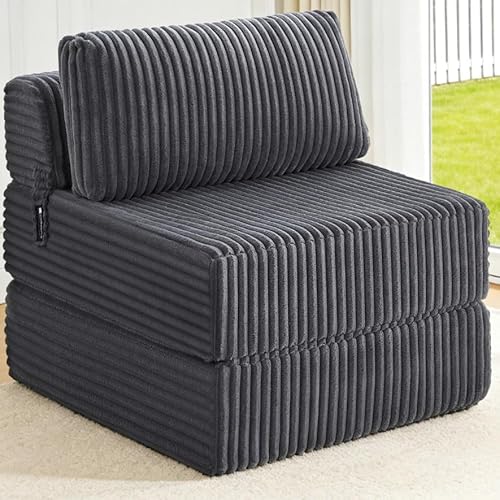
MEGAYES Folding Sofa Bed Convertible 4 in 1 Sleeper Chair Gray Single
Included for 'Fold-Out Foam Chair Bed Guide: Types, Firmness and Everyday Use' as a relevant option in this category; details come from the product listing.
View on Amazon- Tri-fold (stacked panels). Three foam slabs joined by a fabric sleeve fold into a low chair, with one panel as the seat and two stacked behind as the backrest. It’s the cheapest and most common design — usually $60–$150 — but the two hinge lines cross the sleep surface, so check where they land. On a good one they fall under your calves, not your hips.
- Z-fold or flip-forward. The seat panel flips forward and the backrest drops flat, giving a single long seam and a more chair-like upright back. Slightly better to sit in, slightly bulkier to store.
- Cube or box chair. Hinged panels unfold from a dense cube into a flat pad. These often run 6 inches thick (the thickest option) and store the smallest, but the folded cube looks more like an ottoman than a chair.
If sleeping comfort is the priority, favor fewer hinges and thicker panels. If it’s mostly a gaming or reading chair that occasionally hosts a guest, the tri-fold wins on price and shape.
Foam density vs. firmness: two numbers people confuse
Density (measured in lb/ft³) predicts durability — how long the foam resists permanent sag. Firmness (often given as ILD, indentation load deflection) describes how hard the surface feels. You can have firm cheap foam that goes flat in a year, or soft dense foam that lasts a decade. Listings frequently advertise “high density” without a number; if the spec sheet doesn’t state lb/ft³, assume it’s in the budget 1.2–1.5 range.
| Foam type | Typical density | Feel | Trade-off | Best for |
|---|---|---|---|---|
| Standard polyurethane | 1.2–1.8 lb/ft³ | Springy, uniform | Lowest cost; sags fastest under daily use | Kids, occasional guests |
| High-resilience (HR) polyurethane | 2.0–2.8 lb/ft³ | Supportive, pushes back | Costs more; heavier panels | Regular sitting, adult sleepers |
| Memory foam layer over PU core | 3–5 lb/ft³ top layer | Contouring, slow rebound | Sleeps warmer; creases crack over time | Side sleepers, pressure relief |
| Shredded foam fill | Varies | Lumpy, adjustable | Cheapest; uneven sleep surface | Lounging only — not guests |
For firmness, a medium-firm feel around ILD 30–35 suits most adults for both sitting and sleeping. Budget models rarely publish ILD, so density is your better screening number: anything under 1.5 lb/ft³ will show visible crease sag within about a year of daily sitting, while 1.8–2.5 lb/ft³ typically holds its shape for 3–5 years.
Judging comfort: sitting is easy, sleeping is the test
Almost every foam chair is comfortable to sit in for an hour. The failures show up at 2 a.m. Three measurements predict whether a single fold out chair bed works for a real sleeper:
- Thickness when open. Under 4 inches, an adult over roughly 160 lb will feel their hip bottom out against the floor. Look for 5–6 inches for anyone sleeping on it more than a night or two.
- Sleep surface width. Most chair beds open to 25–32 inches wide — narrower than a twin mattress (38 in) and closer to a camping cot. Fine for one person who sleeps still; restless sleepers will roll off the edge.
- Length. Typical open length is 72–78 inches. If your guest is over about 6 ft 1 in, their feet or head will hang off a 72-inch model.
For sitting, note that folded foam chairs sit low — seat heights around 10–16 inches versus roughly 18 inches on a standard dining chair. That’s comfortable for kids and teens but genuinely awkward for older guests or anyone with knee problems to get up from. If grandparents will use it, a thicker cube design that stacks higher is the better pick.
Single chair or a foam fold out sofa bed?
The wider sibling category — the foam fold out sofa bed — uses the same panel concept scaled up to loveseat width. Here’s the honest head-to-head:
| Single fold out chair bed | Foam fold out sofa bed | |
|---|---|---|
| Sleep surface | 25–32 in wide × 72–78 in long | 48–54 in wide × 72–75 in long |
| Folded footprint | ~26 × 30 in | ~50 × 34 in |
| Weight | 8–20 lb | 25–45 lb |
| Sleeps | One adult or child | Two (cozily) or one sprawler |
| Typical price | $60–$250 | $180–$450 |
The sofa version sounds like the better deal until you measure: opened, it needs a clear floor area of about 54 × 75 inches — essentially a full-size mattress footprint — and at 30-plus pounds it’s no longer a one-hand move. In a 10 × 12 ft room, a single chair bed unfolds easily at the foot of a queen bed; the sofa version usually only works if the room’s other furniture clears out of the way. Buy the sofa size only if you regularly host couples or two kids at once.
Match the spec to your situation
| Your situation | Priority | Spec to look for |
|---|---|---|
| Studio apartment, daily seating | Durability | HR foam, 2.0+ lb/ft³, 6 in thick |
| Kids’ sleepovers, pets | Washability and weight | Zip-off machine-washable cover, under 15 lb, any density |
| Renter who moves often | Portability | Tri-fold with carry handles; re-compresses for moving |
| Guests a few times a year | Storage size | Cube or tri-fold that fits a closet shelf or under-bed gap |
| Back pain or nightly use | Support | 6 in thick, ILD 30–35, memory foam top layer |
Storage, moving and setup realities
Two practical points listings skip. First, these ship vacuum-compressed in a box roughly the size of a microwave — they fit through any doorway and up any stairwell, but the foam needs 24–72 hours to expand fully (longer in a cold room), so don’t unbox one the night guests arrive. A mild factory smell for the first few days is normal; foams with CertiPUR-US certification are tested for low VOC emissions if that’s a concern in a small room.
Second, “stores anywhere” has limits. A tri-fold stacked flat is about 12–15 inches tall — it fits under a bed only if your frame has that much clearance, and it slides into a closet upright only if the closet is at least 30 inches deep. If you’ll store it more than a month, keep it flat rather than folded; foam held in a sharp crease develops permanent fold memory and the seat goes lumpy.
What wears out first
Expect wear in this order: the fabric along the fold creases pills or thins first, then the cover zipper (the single most common failure — look for covered or heavy-gauge zippers), then the foam softens at the hinge lines where it bends thousands of times. Rotating which panel becomes the seat — possible on symmetrical tri-folds — spreads that wear. Covers labeled removable should be washed cold and air-dried; heat shrinks them enough that re-zipping over the foam becomes a fight.
FAQ
Can an adult sleep on a fold out foam chair bed every night?
Yes, if it’s 6 inches thick with at least 1.8 lb/ft³ density — but it sleeps low to the floor and narrower than a twin. For nightly use beyond a few months, a thicker folding mattress is a better tool.
How much weight do they hold?
Most list capacities of 200–300 lb. The limit is less about collapse and more about bottoming out — heavier sleepers compress through thin panels onto the floor. Over ~200 lb, treat 6-inch thickness and HR foam as requirements, not upgrades.
Will it work as a permanent chair?
As a casual chair, yes — but the low seat height and soft backrest mean it’s a lounger, not a desk or reading chair. If you’ll sit in it daily, prioritize the Z-fold or cube designs with a firmer, taller back over the cheapest tri-fold.