Key takeaways
- Table depth: 10–14 inches. Under 10 inches becomes useless for lamps and storage.
- Gap behind the table: 1–2 inches if curtains hang inside the room — drapery panels typically project 2–3 inches off the wall, and a table pressed tight against them crushes the fabric and stresses the rod.
- Walkway in front: 30–36 inches of clear passage is comfortable; 24 inches is the bare minimum in a hallway.
- Curtain operation: if you open and close the panels daily, make sure you can reach past the table without leaning across it.
What's inside
A console table in front of a window works in almost any room as long as three numbers are right: the tabletop sits 1–3 inches below the sill, the table is 10–14 inches deep, and nothing blocks curtains, floor vents, or radiators. Get those right and the table frames the window; get them wrong and it looks like furniture parked in the wrong place.
The Height Rule: Read Your Sill First
Most finished windowsills land 24–36 inches above the floor, while most console tables stand 28–34 inches tall — which means the two dimensions overlap constantly. Measure your sill before you shop, not after.

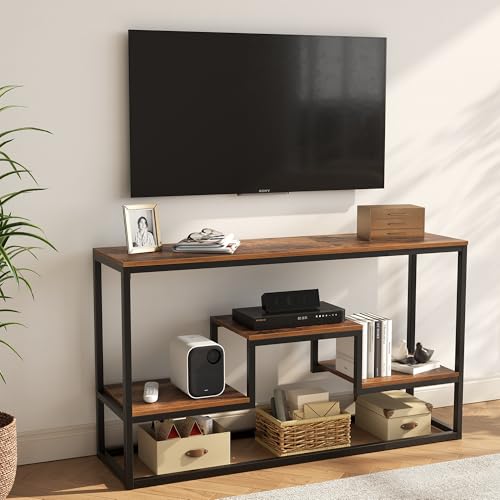
HOOBRO Narrow Console Table, 29.5" Small Entryway Table, Thin Sofa Side Display Table, for Hallway, Bedroom, Living Room, Foyer, Rustic Brown and Black BF75XG01
Included for 'Console Table in Front of a Window: Placement, Height and Light Tips' because the listing specifies 29.5" Small Entryway Table and Thin Sofa Side Display Table, details this guide uses to compare options.
View on Amazon
VASAGLE 31.5" Console Table, Narrow Behind Couch Table, 3 Tier
Included for 'Console Table in Front of a Window: Placement, Height and Light Tips' because the listing specifies Narrow Behind Couch Table and 3 Tier, details this guide uses to compare options.
View on Amazon
Tribesigns 70.9-Inch Console Table, Farmhouse Sofa Table Behind Couch, Narrow Entryway Table for Living Room, Hallway, Foyer, Light Brown
Included for 'Console Table in Front of a Window: Placement, Height and Light Tips' because the listing specifies Farmhouse Sofa Table Behind Couch and Narrow Entryway Table for Living Room, details this guide uses to compare options.
View on Amazon
SUPERJARE 78.8 inch Narrow Behind Couch Table with 2 Charging Stations
Included for 'Console Table in Front of a Window: Placement, Height and Light Tips' as a relevant option in this category; details come from the product listing.
View on Amazon| Sill height from floor | Best table height | What happens otherwise |
|---|---|---|
| 24–28 in (low picture windows, some bays) | 18–24 in, bench-style | A standard 30–32 in table chops the glass in half |
| 29–32 in | 26–29 in | Most forgiving range; standard consoles fit with minor selection |
| 33–36 in | 30–33 in | The sweet spot — nearly every console table qualifies |
| 36+ in (high sills, tall windows) | 34–36 in | Counter-height or tall console needed; standard tables float oddly low |
The 1–3 inch gap below the sill does two jobs: it keeps the tabletop visually separate from the trim, and it leaves room for the sill’s front lip (usually ½–1 inch of overhang) so the table can sit nearly flush to the wall. A tabletop that lands flush with the sill is acceptable; one that lands 1–3 inches above it looks like a measuring error. If your only option runs taller than the sill, commit — pick a table that clearly rises above the lower sash and treat it as a backdrop rather than pretending the window isn’t there.
For width, aim for a table that spans half to two-thirds of the window’s trim-to-trim width, centered. A 60-inch window pairs well with a 36–48 inch console. Going nearly full-width creates a built-in look, but leave 2–3 inches of clearance at each end so the table doesn’t jam against the casing.
Depth, Clearance, and Keeping the Light
Depth is where most window placements fail. A console deeper than 14 inches starts eating into the walkway. Working numbers:
- Table depth: 10–14 inches. Under 10 inches becomes useless for lamps and storage.
- Gap behind the table: 1–2 inches if curtains hang inside the room — drapery panels typically project 2–3 inches off the wall, and a table pressed tight against them crushes the fabric and stresses the rod.
- Walkway in front: 30–36 inches of clear passage is comfortable; 24 inches is the bare minimum in a hallway.
- Curtain operation: if you open and close the panels daily, make sure you can reach past the table without leaning across it.
Open-base designs — hairpin or turned legs, metal frames, lower shelves instead of solid plinths — let daylight pass underneath and keep the window from looking walled off. Glass, acrylic, and mirrored surfaces amplify light; a solid MDF cabinet base absorbs it. Keep most decor at or below the sill line. One taller item (a lamp or vase) placed off-center reads as intentional; a tall object dead-center blocks the view symmetrically, which reads as a mistake.
Heat Vents and Radiators: What Not to Block
Windows are the most common location for heating equipment, and this is the placement detail listings never mention.
- Floor registers: never set a solid-base table over one. Either pick an open-leg frame that spans the vent so air rises around it, or shift the table 6+ inches to one side. A vent deflector under the table is a workable fallback.
- Hot-water baseboard heaters: manufacturers generally want drapes and furniture 6–12 inches clear of the cover front, and nothing resting on top. Rising heat dries wood joints and lifts veneer — metal-frame tables tolerate this zone far better than engineered wood.
- Radiators: keep the tabletop roughly 6–12 inches in front of the radiator face and leave air space above it. The surface will still run warm, so skip candles, plants that hate dry heat, and anything wax-based.
- Sun damage: south- and west-facing windows deliver enough UV to fade dark veneer within a couple of seasons and yellow acrylic over time. Sealed solid wood and powder-coated metal hold up best; a sheer shade cuts exposure without killing the light.
Anchoring Without Drilling Into Trim
Window casing is decorative softwood or MDF over shims — screws into it split the profile, leave visible holes, and hit nothing structural. Anchors belong in studs or drywall.
Your options, strongest first:
- Strap to the studs flanking the window. Windows are framed by king and jack studs sitting directly beside the casing. Run a furniture anti-tip strap from the table’s back rail to a stud on one side — a stud finder will locate them in seconds. This is invisible from the front and leaves the trim untouched.
- Drywall anchors. If no stud lines up, two straps into toggle-style drywall anchors rated 50+ lbs each handle tip-over loads easily.
- No-drill for renters. Adhesive-backed anti-tip straps exist and are better than nothing, though they can peel paint on removal. Pair them with a heavier table — solid wood or steel frames over 40 lbs resist tipping on their own — plus rubber gripper pads under the legs and clear bumpers where the table back meets the wall, so it never scuffs the trim or sill.
Anchoring matters most with kids, climbing cats, or a top-heavy table loaded with a lamp. A 30-inch-tall table on 10-inch-deep legs is tippier than it looks.
Choosing a Console Table for a Bay Window
A bay window changes the geometry. The side panels angle back at roughly 30 or 45 degrees, so a straight console sized to the whole bay leaves wedge-shaped dead zones at both ends. Three approaches work:
- Size the table to the center panel only. Measure the flat middle section trim-to-trim and buy for that width. The gaps at the angled sides read as intentional.
- Use two narrow tables (18–24 inches each) on the angled side panels for a symmetrical flanking arrangement.
- Choose a demilune or curved-front table, which echoes the bay’s sweep and softens the straight-line mismatch.
Bay sills often run 8–14 inches deep — deep enough that the table sits comfortably under the sill line. Because a bay projects into the room, keep at least 30 inches of clearance between the table and whatever sits opposite it. If the bay sill is low, a bench-height console (18–20 inches) can double as a perch — but only if it’s rated for it. Typical console tables carry 50–150 lbs on top; seating requires a stated 250+ lb rating.
Sofa Table in Front of a Window
When a sofa floats in front of a window, the table behind it follows sofa rules first and window rules second. A sofa table should sit level with the sofa back or 1–2 inches below it — and since sofa backs run 30–36 inches, the top may end up above the windowsill. That’s fine. Keep the decor on the table below the sill height so the glass reads as unobstructed, and the layered look (sofa, table, window) still works.
Other numbers: sofa tables run 12–16 inches deep; leave 1–2 inches between the sofa back and the table edge so cushions don’t rub, and 4–6 inches between the sofa and the window itself for curtain movement and airflow. Tables with a lower shelf earn their footprint here — that’s where routers, chargers, and power strips live, with cords dropping behind the sofa instead of across the floor.
Material Trade-offs for a Sunny, Drafty Spot
| Material | Holds up to sun/heat | Weakness | Typical price (2026) |
|---|---|---|---|
| Solid wood (oak, acacia, pine) | Good if sealed; refinishable if it fades | Can dry and crack beside radiators | $300–$800 |
| Engineered wood / MDF veneer | Poor — veneer lifts and fades with heat and UV | Cannot be refinished; edge banding fails first | $100–$300 |
| Powder-coated metal + glass | Excellent — ignores heat, slim sightlines | Glass shows smudges and glare | $150–$500 |
| Acrylic / lucite | Fair — scratch-resistant formulas exist, but UV yellowing over years is real | Scratches; static attracts dust | $200–$700 |
| Rattan / cane accents | Fair | Dries and brittles near heat vents | $150–$450 |
Quick Picks by Situation
| Your situation | Best spec |
|---|---|
| Renter, no drilling allowed | 10–12 in deep metal frame, adhesive anti-tip kit, rubber leg pads, under $300 |
| Radiator or baseboard under the window | Open-base powder-coated metal; decor 6+ in above the heater line |
| Kids and pets | Rounded corners, 40+ lb solid wood or steel, strap to the flanking studs; skip glass tops |
| Narrow room or hallway window | 10–11 in depth, acrylic or slim metal to keep sightlines open, 30 in walkway preserved |
| South-facing glare | Sealed solid wood or metal; skip acrylic and dark veneer |
| Bay window | Table sized to the center panel, or a demilune front |
FAQ
Can a console table be taller than the windowsill?
Yes, but commit to it. A top that lands 1–3 inches above the sill looks accidental; a table that clearly rises above the lower sash reads as a deliberate backdrop — keep decor low so it doesn’t pile up against the glass.
How much weight can a console table hold?
Most are rated 50–150 lbs on the top surface — enough for lamps, books, and trays, not for sitting. Only bench-style consoles with a stated 250+ lb capacity should double as seating.
Does a console table under a window need anchoring?
In a household with kids, pets, or earthquakes: yes — strap to the studs beside the window, never into the casing. In a quiet adult household with a heavy table, grippy pads and bumpers are usually sufficient.
How tall should decor be on a window console?
Keep the tallest object at roughly half the visible glass height or less, and push it off-center. Two medium lamps flanking the ends almost always look better than one tall centerpiece blocking the view.