Key takeaways
- 28-30 in. table: pair with 24-26 in. counter-height stools. This is the most common combo and works for eating a quick meal or setting a laptop down.
- 30-32 in. table: pair with 25-26 in. stools, or 24 in. if you want extra knee clearance for taller users.
- Bar-height tables (36-40 in.): need 28-30 in. stools. These look striking but rarely make sense behind a standard sofa since the table towers well above the sofa back and can visually cut the room in half.
What's inside
- Behind the Couch Table With Stools: Sizing, Heights, and Clearance
- The Height Math: Why 28-32 Inches Is the Sweet Spot
- The 18-24 Inch Walkway: Non-Negotiable Clearance
- Tuck-Under Depth: The Detail Product Photos Never Show
- Decision Matrix: Matching the Set to Your Layout
- Material Trade-offs: What Holds Up Behind a Sofa
- Storage, DIY, and Styling Notes
- Assembly and Moving Notes
Behind the Couch Table With Stools: Sizing, Heights, and Clearance
A behind-the-couch table with stools works when the table sits 28-32 inches tall, the stools measure 24-26 inches, and you leave at least 18-24 inches of walkway between the table and the sofa back. Get any of those three numbers wrong and you end up with knees jammed under the tabletop, stools that don’t tuck away, or a hallway too narrow to pass through. This piece walks through the exact pairings that work, why tuck-under depth matters more than table length, and how to decide between an open-plan layout and a wall-backed one.
- Behind the Couch Table With Stools: Sizing, Heights, and Clearance
- The Height Math: Why 28-32 Inches Is the Sweet Spot
- The 18-24 Inch Walkway: Non-Negotiable Clearance
- Tuck-Under Depth: The Detail Product Photos Never Show
- Decision Matrix: Matching the Set to Your Layout
- Material Trade-offs: What Holds Up Behind a Sofa
- Storage, DIY, and Styling Notes
- Assembly and Moving Notes
The Height Math: Why 28-32 Inches Is the Sweet Spot
A sofa back typically sits 30-36 inches off the floor, so a console or sofa table needs to land close to that range to look intentional rather than floating or squat. Most behind-the-couch tables land between 28 and 32 inches, which also happens to be counter height, not bar height. That distinction drives your stool choice.

HOMYSHOPY Bar Table Set for 3, 4 Piece Console Table with 3 Stools, Counter Height Sofa Table Set with 3 Chairs for Breakfast Nook, Living Room and Apartment (Brown)
Included for 'Behind the Couch Table With Stools: Sizing, Heights, and Clearance' because the listing specifies 4 Piece Console Table with 3 Stools and Living Room and Apartment (Brown), details this guide uses to compare options.
View on Amazon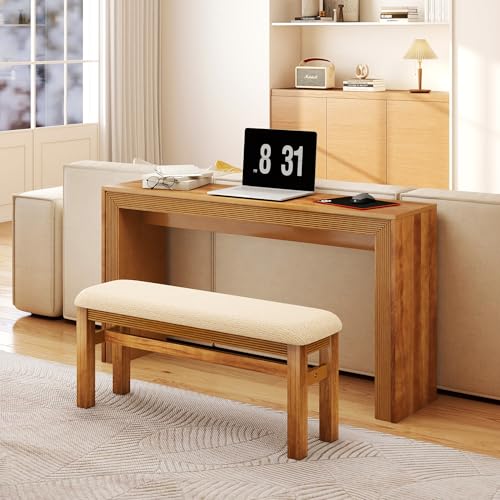
BFJDM Counter Height Bar Table Set for 2, Dining Table Behind Couch with Upholstered Bar Stool Fluted Bar Table Set for Kitchen, Living Room, Brown
Included for 'Behind the Couch Table With Stools: Sizing, Heights, and Clearance' because the listing specifies Living Room and Brown, details this guide uses to compare options.
View on Amazon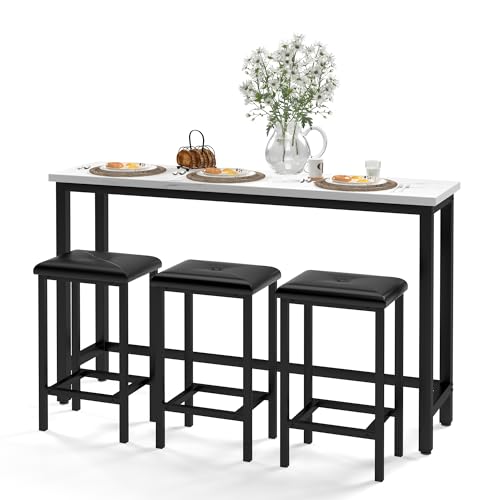
COCLUB Bar Table Set for 3, 60.2” Faux Marble Behind Couch Table Set, Modern Sofa Table with 3 Upholstered PU Stools, Space-Saving Bar Tables and Stools for Home, Apartment, Small Spaces (Black)
Included for 'Behind the Couch Table With Stools: Sizing, Heights, and Clearance' because the listing specifies 60.2” Faux Marble Behind Couch Table Set and Modern Sofa Table with 3 Upholstered PU Stools, details this guide uses to compare options.
View on Amazon
Signature Design by Ashley Counter Height Dining Table, 72-in Behind Couch
Included for 'Behind the Couch Table With Stools: Sizing, Heights, and Clearance' because the listing specifies 72-in Behind Couch, details this guide uses to compare options.
View on Amazon- 28-30 in. table: pair with 24-26 in. counter-height stools. This is the most common combo and works for eating a quick meal or setting a laptop down.
- 30-32 in. table: pair with 25-26 in. stools, or 24 in. if you want extra knee clearance for taller users.
- Bar-height tables (36-40 in.): need 28-30 in. stools. These look striking but rarely make sense behind a standard sofa since the table towers well above the sofa back and can visually cut the room in half.
The rule of thumb that carries over from dining tables applies here too: leave 9-13 inches between the seat of the stool and the underside of the tabletop. A 30-inch table with a 26-inch stool gives you 4 inches, which is too tight for adult knees. A 30-inch table with a 24-inch stool gives you 6 inches, still snug but workable for backless or swivel stools that let you sit at an angle.
| Table Height | Recommended Stool Height | Knee Clearance | Best For |
|---|---|---|---|
| 28 in. | 24 in. | ~6-7 in. | Kids, shorter adults, snug layouts |
| 30 in. | 25-26 in. | ~5-6 in. | Most households, standard sofa backs |
| 32 in. | 26 in. | ~6-7 in. | Taller users, higher sofa backs |
| 36-40 in. (bar height) | 28-30 in. | ~7-8 in. | Open lofts, rooms with high ceilings |
The 18-24 Inch Walkway: Non-Negotiable Clearance
This is the number people skip and regret. Behind the sofa, you need 18-24 inches of clear floor between the sofa back and the table’s front edge, and that same 18-24 inches has to remain open on the far side of the table once a stool is pulled out and someone is sitting in it. If the table backs onto a walkway that connects two rooms, push toward 24-30 inches so two people can pass without turning sideways.
In a small apartment, this often means the table itself has to shrink rather than the walkway. A long skinny table for behind the couch, something 12-16 inches deep instead of the standard 18-20 inches, buys back several inches of walking room without touching the clearance zone on either side. A long thin table for behind the couch also reads better visually in a narrow room since it doesn’t compete with the sofa’s own depth.
Measuring It in a Real Room
In a 10×12 ft living room with a 7-foot sofa centered on the long wall, you typically have 3-4 feet of depth behind the sofa before hitting a wall or walkway. Subtract 18-24 inches for clearance and the table itself, and a slim behind-the-couch table 12-14 inches deep with stools tucked fully under leaves a comfortable 20+ inches to walk through. If the same room is open-plan and the sofa floats in the middle, that walkway becomes a thoroughfare, and you’ll want the full 24 inches minimum, more if kids or pets regularly cut through the space.
Tuck-Under Depth: The Detail Product Photos Never Show
The single biggest factor in whether a stool set fits your layout is tuck-under depth, meaning how far the stool slides under the tabletop when not in use. This number rarely appears in a product listing, but it determines everything.
- Full tuck-under (stool seat and legs disappear completely under the table): needs a table depth of at least 16-18 inches and stool footprint of 14-15 inches. This is what makes a set work in a tight, wall-backed hallway layout, since the walkway measurement is taken with stools stored, not pulled out.
- Partial tuck-under (stool back or a portion of the seat sticks out): common with backed stools or swivel stools with a wider base. Add 4-6 inches to your walkway calculation to account for the permanent intrusion into the walking path.
- No tuck-under (stools sit beside the table, not under it): only works in open-plan rooms with generous floor space on both sides, since the stools become permanent floor clutter rather than storable seating.
If your table sits against a wall in a hallway-style layout, full tuck-under is close to mandatory. Table behind couch against wall setups are usually the tightest configuration in the house, and a stool that doesn’t fully retreat under the table will get bumped every time someone walks by. In a true open-plan great room where the back of the sofa doesn’t border a walkway, partial or even no tuck-under stools are fine, since the “waste” of space around them doesn’t interfere with foot traffic.
Decision Matrix: Matching the Set to Your Layout
| Your Situation | Table Depth | Stool Type | Why |
|---|---|---|---|
| Small apartment, sofa against a wall | 12-14 in. | Backless, full tuck-under | Maximizes walkway without shrinking the room |
| Sofa floats in an open floor plan | 16-20 in. | Swivel or backed, partial tuck-under fine | No walkway constraint on the far side |
| Hallway or entry doubles as the walkway | 12-16 in. | Full tuck-under, lightweight to move | Stools must disappear completely between uses |
| Kids or pets in the house | Any | Rounded edges, lower 24 in. height | Reduces injury risk and tip-over with lighter stools |
| Renters, plan to move often | Any | Lightweight wood or metal-frame stools under 15 lbs each | Easier to relocate and won’t scuff floors when dragged |
Material Trade-offs: What Holds Up Behind a Sofa
Because this table gets bumped by knees, drinks, and the occasional foot going up on it, material choice matters more than it would for a purely decorative console.
| Material | Durability | Weight | Trade-off |
|---|---|---|---|
| Solid wood | High, resists dents | Heavy, 40-70 lbs assembled | Best longevity but harder to move solo and usually $300-$700 |
| Engineered wood (MDF/particleboard veneer) | Moderate, veneer can chip at edges | Light-moderate, 25-45 lbs | Budget-friendly, usually $120-$300, but weaker at corners over years |
| Metal frame with wood or glass top | High frame durability, top varies | Light, 15-30 lbs | Easiest to move for renters, but glass tops show scratches and fingerprints |
Storage, DIY, and Styling Notes
If floor space is tight, a behind-the-couch table with storage, shelving underneath, drawers, or a lower display shelf, does double duty by holding lamps, books, or coasters that would otherwise clutter the top. Just confirm the lower shelf doesn’t interfere with stool tuck-under depth; a shelf that runs the full length of the underside can block stools from sliding all the way in.
A DIY behind-the-couch table is a reasonable weekend project if you’re comfortable with basic joinery: a 12×60-inch pine or plywood top on simple hairpin or trestle legs, cut to 30 inches finished height, costs roughly $60-$120 in materials and skips the assembly-day box weight problem entirely, since you build it in place.
For decorating a sofa table behind a couch, keep the tallest object no higher than the sofa back so it doesn’t visually block the room, and leave one end clear for setting down drinks or a laptop rather than styling every inch with décor. A table lamp, a low tray, and one or two stacked books is usually enough; overloading a narrow table makes the walkway feel even tighter than it measures.
Assembly and Moving Notes
Behind-the-couch tables with stools typically ship in one box for the table and separate boxes per stool, with total shipping weight often landing between 60-120 lbs combined. Check doorway width before ordering a solid wood table longer than 55-60 inches; anything wider than a standard 30-inch doorway diagonal will need to come in at an angle or through a wider opening. Stools with a full tuck-under base are usually the easiest single-person carry, often under 15 lbs each, while a solid wood table top over 50 inches is a two-person lift for assembly and for any future rearranging.